

On the left side was a densely wooded rocky hill. Its steep slope was carved into fantastic figures of unicorns, leogryphs and other mythological animals, and statues of gods and saints. They had been fashioned out of rock by the monks more than fifteen centuries ago. Under the hill were grottoes and caves filled with Buddhas and genii, where pilgrims were burning incense. Mantras in Sanskrit and archaic Chinese adorned the rocks, chiselled by the long departed hermits.]
Walking a little farther we came to the spacious entrance hall of a monastery which was unique in China in its grandeur, sanctity.
‘The Monastery of the Spirit’s Retreat’, softly exclaimed Chungan pointing to the three huge golden characters over the wide-open doors of the hall.
‘What a deep and secret meaning these words possess ! ‘ he continued. ‘It is a fitting name for this place, for it is difficult to conceive a better hermitage for the spirit of a man tired of the world and seeking concealment amidst the beautiful and tranquil.
Having emerged from this hall with its golden statue of Maitreya, the Lord Buddha of the Future, we stepped out into a large stone-flagged courtyard bounded by ancient trees. In front of them, on a high stone platform, flanked by two small pagodas and with a massive bronze incense burner in the middle, stood the main temple hall. its great height and immense size dwarfed all other buildings around it. The roof rose in three nobly curved tiers supported by colossal red wooden pillars.
The latticed gates of the hall were open as we came in. A mysterious semi-darkness, heavy with the odour of sandal-wood incense, pervaded the place. Right in the middle of the vast temple sat three golden Buddhas of such unbelievable majesty and of such gigantic proportions that when I saw them I was astonished. The images rested on lotus flowers which, in turn, were supported by stupendous stone pedestals. A colossal lantern, richly carved and decorated, with a perpetually-burning oil-lamp within, was suspended in front of the Trinity.
The central figure was that of the Lord Buddha himself with his royal coiffure and a sign of urna on his forehead. With the eyes turned inwards, gazing not at the world outside before him but at the world within himself; with his enigmatic smile, he sat there a true image of the man that he once was, but who had transcended all human emotions, desires, all suffering and mundane joy; who had found the lost path to Heaven and shown it to suffering mankind, and who at last had entered Nirvana and became himself a God. I gazed enchanted at the mystic statue. I felt mesmerized by the utter stillness of the temple. Clouds of incense floated in spirals towards the lofty ceiling and gently dissolved there in the golden rays of the sun coming through the narrow windows. The very silence was pregnant with the meaning of things unsaid, of prayers uttered and of petitions yet unoffered.
After we had finished our tour of the golden statues of arhats, lining the walls, and paused before an enormous image of the gentle Goddess Kwanyin, which stood against an altar piece representing the Western Paradise, we made our exit by a side door into a commodious guest hall where a young novice brought us cups of the monastery’s own tea. He smiled at Chungan and Tsungpoo, evidently recognizing them as frequent visitors. After a good rest we were ready to proceed to the next famous temple.
Goullart, Peter. Monastery of the Jade Mountain.
Peter Goullart. The monastery of Jade Mountain.
More posts on Chinese culture

Midnight by Mao Dun – a failed novel
Midnight by Mao Dun - a failed novel Before reading "Midnight", the masterpiece of Mao Dun, the most powerful Chinese writer in the twentieth century, reading the presentations of the Chinese edition, one wonders why such a great literary treasure is not better known...

Cold Steel – A Sniper’s War
Cold Steel - A Sniper's War If in the West war films are a genre in their own right, in China they are an even more important genre, and that is because there is always an interest on the part of the official media to remember the two great war events that gave rise...

A Woman, a Gun and a Noodle Shop
A Woman, a Gun and a Noodle Shop Directed by Zhang Yimou: 2009. 85. Min. A Woman and a Gun and a Chinese Noodle House is a quite singular work within Zhang Yimou's filmography. His light-hearted style starts from the first scenes, in which we see the protagonist with...
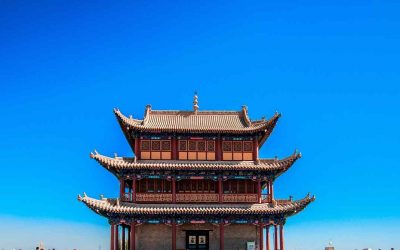
Jiayuguan Pass – the Great Wall on the Silk Road
Jiayuguan Pass - the Great Wall on the Silk Road Jiayuguan Pass or Jiayu Pass, as guan means pass in Chinese is one of the most remarkable monuments on the Silk Road and one of its most popular sights. Built at the end of the Great Wall, showing the desolation of the...

Springtime in a Small Town: The best film in China’s history
Springtime in a Small Town: The best film in China's history All the rankings made in recent years, place a film, unknown to the general public, as the best film in China. It is called "Springtime in a Small Town" and was directed by Fei Mu in 1948. I had been wanting...
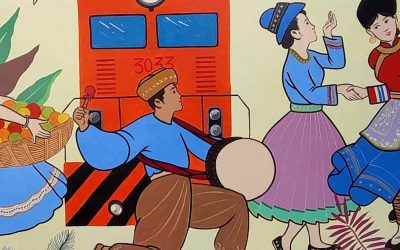
The Character and Function of Music in Chinese Culture
The Character and Function of Music in Chinese Culture In 1946 Bliss Wiant finished his Doctoral dissertation . The subject was “The character and function of Music in Chinese culture.” Some of his reflections are so interesting that I share with readers here some...
More posts on China ethnic groups
The Baoan, master sword makers in the Silk Road
The Baoan, master sword makers In the dry lands of Gansu province, at the foot of the Jishishan mountain, there are three villages inhabited by different people. At first glance, their life is the same as that of any other Muslim population in that vast region crossed...
The goddess of the Sun of the Jingpo
The goddess of the Sun of the Jingpo The goddess of the Sun was in the sky when one day she realized that on Earth the situation of men had changed a great deal. When they were created, they were all equal, and without evil and they did not covet riches. The latest...
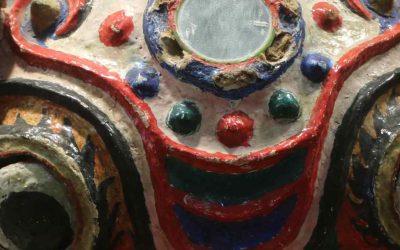
Funeral Masks of the Zhuang people in the Nationalities Museum of Kunming
Funeral Masks of the Zhuang people in nationalities Museum of Kunming Known as Longyawai Masks, they are funeral ceremony masks popular in the Zhuang communities of Wenshan Autonomous Prefecture, on the east of Yunnan Province. The masks are shaped as a lion, they are...
The creation of the world among the Wa of China
The creation of the world among the Wa of China As soon as the heaven was formed, it looked like the back of a toad, full of lumps and protrusions, it was very ugly. The god Li[i] extended his hands and was polishing without stopping. Nobody knows how many years he...
The Jinuo, descendants of the uncle
The Jinuo, descendants of the uncle The Jino, with a population of only 21.500 persons (in 2005) are one of the smallest minorities in China and the last to be officially recognized as such, as they were designated a national minority and granted the special rights...
The Blue Women of China of the Yao minority
The Blue Women of China of the Yao minority Many people have heard of the Blue Men of the Sahara (the Tuareg), but few have heard of the Blue Women of China. And in fact among the women of the so-called Landian Yao or Landen Yao outside China, the production, dyeing...