

The Dong are one of the minorities of China with a large population. According to the census of the year 2000 their population was 3,000,000 people.
They live mainly in Guizhou Province (approximately 1,800,000 people), along a fringe of flat lands that cross the province from north to south. There is also a big Dong population in the southern part of neighboring Hunan Province (about 900,000), and more than 200,000 persons in Guangxi Zhuang Autonomous Region, and a few thousand in Hubei Province (Enshi Prefecture).
The Dong, as do most of the peoples related to them, live near the rivers or in hills generally not of great height. They mainly cultivate rice. They raise domestic animals, especially hens and pigs. The exploitation of the forests, which holds a special spiritual relationship with the Dong, is an activity of economic importance.
They refer to themselves as «Kam.»
It is generally considered that there are two quite different types of Dong, the Dong of the North and the Dong of the South.
There are important linguistic and cultural differences between them. In general those of the north have received more influences from mainstream Chinese culture, while those of the south better conserve the Dong traditions. The typical monuments of the Dong, such as Drum Towers, Bridges of Rain and Wind, and the Temples of the Goddess Mother Sama, are all characteristic of the Dong of the South.
Their language belongs to the Sino-Tibetan family, Dong Dai branch, Zhuang Dong sub-branch. It has two main dialects, understandably called the northern and southern dialects, whose speakers cannot understand each other easily. Each one of these dialects has in turn three clearly differentiated local sub-dialects.
After 1958 an alphabet was invented for their language, but it has not been widely used. Before 1958, they used Chinese characters adapted to their own language.
More posts on China ethnic groups
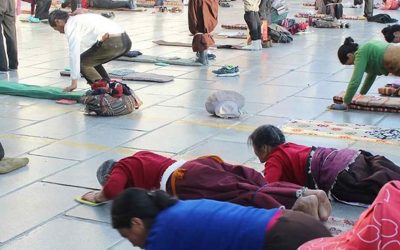
Ritual prostrations of Tibetan pilgrims
Ritual prostrations of Tibetan pilgrims The end of the path of any pilgrimage is a temple or mountain considered the abode of the gods. Reaching it is the culmination of the journey. At that moment the pilgrims, in spiritual bliss, pay homage to the gods in two ways:...
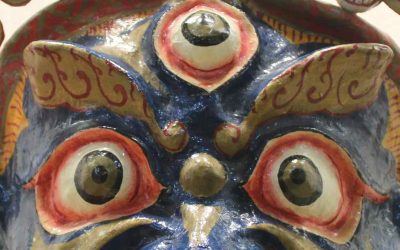
Mask of the Protector Palden Lhamo
Mask of the Protector Palden Lhamo Palden Lhamo is one of the main protector deities of Tibetan Buddhism. Among her many roles, she is the special protector of the city of Lhasa, the Gelugpa order of Tibetan Buddhism, and the Dalai Lamas of Tibet. She was invited to...
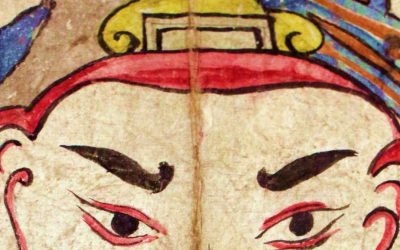
«Dujie» (Initiation Rite) Masks of the Yao people
"Dujie" (Initiation Rite) Masks of the Yao people Popular among the Yao people in Wenshan and Honghe Prefectures, the Dujie masks are used for the ceremonies of the boys' rites of passage. The ceremony, performed for boys that are about fourteen years...
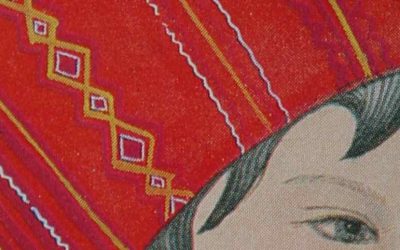
The headdress of the Jingpo women
The headdress of the Jingpo women The clothing style of the Jingpo people is rough and bold, It is possible that it reflects that past time when they were the masters of the frontier mountains, and caravans had to pay a tax to pass through their lands. Men of the...
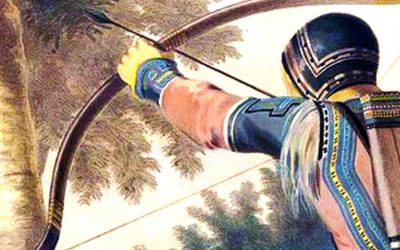
Pictographic writing among the Evenki
Pictographic writing among the Evenki In Chi Zijian’s novel The Last Quarter of the Moon (English translation by Bruce Humes) there is a short story describing the creation of pictographs to write the Evenki language. “Shiban had two great loves: creating Evenki...
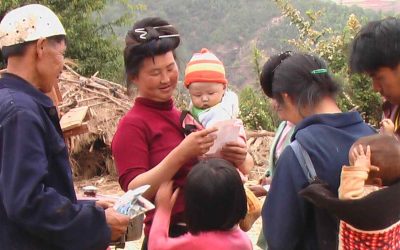
The Flowery Miao in Zhaotong
The Flowery Miao in Zhaotong As depicted by E. G. KEMP in The Face of China. New York. 1909. The prefectural town of Zhaotong was reached after passing through a dull plain, across which a piercing wind was blowing, which is characteristic of this district. It is an...