

From Leyendas de la Diosa Madre. Pedro Ceinos Arcones. Miraguano, 2007.
Anyone who approaches the literature of the minorities of Southern China will discover numerous works where the leading role is played by a female goddess or deity. Whether dedicated to the creation of the world (alone or in the company of a male deity), of the human race, or to the instruction of humanity or its ancestors in the basic notions of Neolithic culture (hunting, agriculture, stock breeding), female deities play a central role in the origin and development of humanity.
In recent times numerous works have been published defending the matriarchal character of a great part of the societies formerly established in the territory of Europe and the Near East, characterized by the cult of a goddess in her diverse manifestations: as a creator of the cosmos and of humanity, as an initiator in the secrets of existence and as a renewer of the world in an alternation of life and death that allows the continuity of everything that exists. This is an issue on which there has been no unanimity among the academic community and instead remains at the centre of a bitter debate with obvious political connotations.
Precisely because it is a subject in permanent debate, and because of the consequences it may have for the present life, I have considered it necessary to provide some facts related to the peoples of China.
My interest in the cultures of China’s minorities led me to learn about the existence of societies, such as the Moso, where inheritance is transmitted through the female line and social life is organized around matrilineal families; that of the Jino, who had female leaders until a few generations ago; that of the Yi, also with numerous female leaders; or that of the Lahu with their manifest gender equality. This series of events led me to wonder whether it would be possible to establish a cultural relationship, at least hypothetical, between the matriarchal societies of the ancient West, and those of the present, or of the near past documented in historical sources, of the Far East, in which women played the predominant role.
Going deeper into the culture of the indigenous peoples of China, I found numerous myths, legends, historical descriptions, rituals, and customs that suggest that in the more or less distant past, women occupied an outstanding social position. Among their myths, I was particularly struck by the many stories that highlight the creating or civilizing role of women, as well as those that describe in detail how women lost the dominant role in their societies.
As I discovered new myths that reinforced the role of women in China’s indigenous societies, my desire to find others like them in different social systems grew. As a result of this somewhat obsessive research, I ended up gathering together an interesting treasure trove of narratives that, encompassing the peoples inhabiting in different regions of China, make women the protagonists of history. Thus, what was initially only part of an effort to document the position of women in the societies of minorities, which should also include rituals, customs, and historical descriptions, took on such a volume that I felt it appropriate to translate and present these myths, with enormous interest in themselves, while continuing to investigate the traces of these ancient Chinese matriarchal societies in the minorities cultures of modern China.
By temporarily abandoning my research on Chinese matriarchy and replacing it with the translation of these myths, I realized that the interest in these narratives is multi-faceted: first, because they present the reader with a series of stories, most of which have never been translated into any Western language; second, because they make it possible to know some of the most common motives in the mythologies of the peoples of China (creation of the world, flooding, marriage of brothers, appearance of numerous suns, etc.); third, because they cover geographical regions so far away as to suggest the validity, at least for East Asia, of their subject matter; fourthly, due to their homogeneity in the positive treatment of the female deities which contrasts with other mythical narratives where they play a permanently negative role, and lastly because in a society which still stands on a framework that is tremendously hostile towards women, with tragic results on numerous occasions. Any work aimed at claiming their importance can become a drop in the great tide destined to reverse the present situation.
This work is not extensive, the narrations presented here can hardly be considered a small sample of the vast feminine mythology of the peoples of China. There are many myths that have been left out: either because they are too long, because they are too similar to some of the myths included, or because due to their complex symbolic language they would be difficult to understand for the general reader.
More posts on Chinese culture
The Filial Peasant Girl – A Buddhist Miracle Tale
The Filial Peasant Girl - A Buddhist Miracle Tale With the arrival of Buddhism in China, in addition to translating the main canonical scriptures, other more popular religious literature began to emerge, which by means of some tales narrating either the benefits of...

Shock Wave 2- An entertaining action movie
Shock Wave 2- An entertaining action movie In short: A nice movie, with an original script, plenty of surprises, the right dose of love, and a slightly exaggerated dose of violence, but nothing excessive for what is fashionable nowadays. The year 2020 seems to have...

Hong Ying- An Art of Love without art and without love
Hong Ying- An Art of Love without art and without love In Brief: A scandalous novel that fails to shock, and an art of love that is conspicuous by its absence. Already from the beginning, we know that this is a love story without a future because the novel begins with...
Black Coal, Thin Ice, by Diao Yinan
Black Coal, Thin Ice, by Diao Yinan In short: a film narrated in a gray and sometimes sordid atmosphere, in a dark winter, of climate and spirit, which presents a mystery in which the viewer is gradually seduced. In an eminently mining region, human limbs begin to...

Xian, the ancient imperial capital
Xian, the ancient imperial capital In short: The ancient city inside the city wall retains a fascinating atmosphere. Its great monuments on the outskirts, such as the Terracotta Warriors, are among China's favorite attractions. Xian is undoubtedly one of the most...

Xin Ran – Sky Burial: An Epic Love Story of Tibet
Xin Ran - Sky Burial: An Epic Love Story of Tibet In Brief: A work full of exoticism that describes some interesting customs of the Tibetan nomads, but fails to convey emotions to the reader. Sky Burial: An Epic Love Story of Tibet is a novel set in the late 1950s. A...
More posts on China ethnic groups
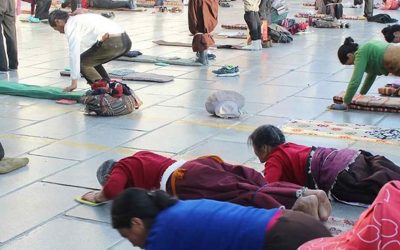
Ritual prostrations of Tibetan pilgrims
Ritual prostrations of Tibetan pilgrims The end of the path of any pilgrimage is a temple or mountain considered the abode of the gods. Reaching it is the culmination of the journey. At that moment the pilgrims, in spiritual bliss, pay homage to the gods in two ways:...
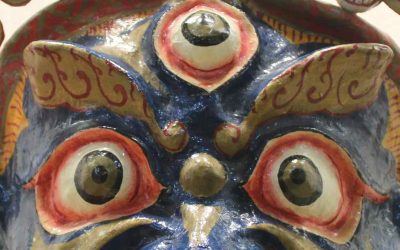
Mask of the Protector Palden Lhamo
Mask of the Protector Palden Lhamo Palden Lhamo is one of the main protector deities of Tibetan Buddhism. Among her many roles, she is the special protector of the city of Lhasa, the Gelugpa order of Tibetan Buddhism, and the Dalai Lamas of Tibet. She was invited to...
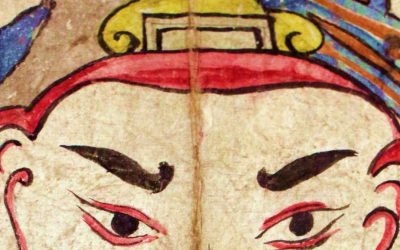
«Dujie» (Initiation Rite) Masks of the Yao people
"Dujie" (Initiation Rite) Masks of the Yao people Popular among the Yao people in Wenshan and Honghe Prefectures, the Dujie masks are used for the ceremonies of the boys' rites of passage. The ceremony, performed for boys that are about fourteen years...
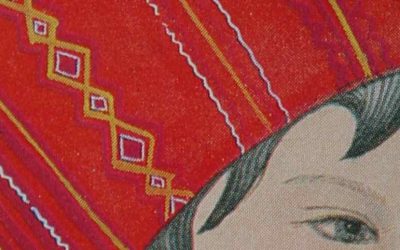
The headdress of the Jingpo women
The headdress of the Jingpo women The clothing style of the Jingpo people is rough and bold, It is possible that it reflects that past time when they were the masters of the frontier mountains, and caravans had to pay a tax to pass through their lands. Men of the...
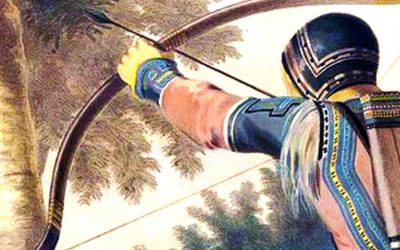
Pictographic writing among the Evenki
Pictographic writing among the Evenki In Chi Zijian’s novel The Last Quarter of the Moon (English translation by Bruce Humes) there is a short story describing the creation of pictographs to write the Evenki language. “Shiban had two great loves: creating Evenki...
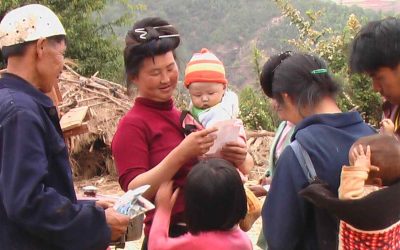
The Flowery Miao in Zhaotong
The Flowery Miao in Zhaotong As depicted by E. G. KEMP in The Face of China. New York. 1909. The prefectural town of Zhaotong was reached after passing through a dull plain, across which a piercing wind was blowing, which is characteristic of this district. It is an...