

From Leyendas de la Diosa Madre. Pedro Ceinos Arcones. Miraguano, 2007.
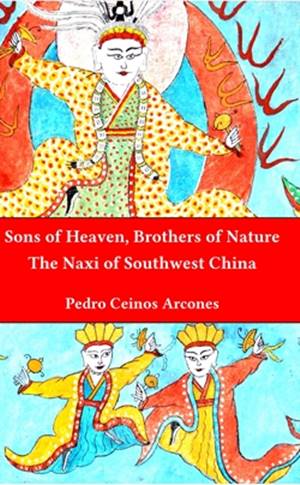
Anyone who approaches the literature of the minorities of Southern China will discover numerous works where the leading role is played by a female goddess or deity. Whether dedicated to the creation of the world (alone or in the company of a male deity), of the human race, or to the instruction of humanity or its ancestors in the basic notions of Neolithic culture (hunting, agriculture, stock breeding), female deities play a central role in the origin and development of humanity.
In recent times numerous works have been published defending the matriarchal character of a great part of the societies formerly established in the territory of Europe and the Near East, characterized by the cult of a goddess in her diverse manifestations: as a creator of the cosmos and of humanity, as an initiator in the secrets of existence and as a renewer of the world in an alternation of life and death that allows the continuity of everything that exists. This is an issue on which there has been no unanimity among the academic community and instead remains at the centre of a bitter debate with obvious political connotations.
Precisely because it is a subject in permanent debate, and because of the consequences it may have for the present life, I have considered it necessary to provide some facts related to the peoples of China.
My interest in the cultures of China’s minorities led me to learn about the existence of societies, such as the Moso, where inheritance is transmitted through the female line and social life is organized around matrilineal families; that of the Jino, who had female leaders until a few generations ago; that of the Yi, also with numerous female leaders; or that of the Lahu with their manifest gender equality. This series of events led me to wonder whether it would be possible to establish a cultural relationship, at least hypothetical, between the matriarchal societies of the ancient West, and those of the present, or of the near past documented in historical sources, of the Far East, in which women played the predominant role.
Going deeper into the culture of the indigenous peoples of China, I found numerous myths, legends, historical descriptions, rituals, and customs that suggest that in the more or less distant past, women occupied an outstanding social position. Among their myths, I was particularly struck by the many stories that highlight the creating or civilizing role of women, as well as those that describe in detail how women lost the dominant role in their societies.
As I discovered new myths that reinforced the role of women in China’s indigenous societies, my desire to find others like them in different social systems grew. As a result of this somewhat obsessive research, I ended up gathering together an interesting treasure trove of narratives that, encompassing the peoples inhabiting in different regions of China, make women the protagonists of history. Thus, what was initially only part of an effort to document the position of women in the societies of minorities, which should also include rituals, customs, and historical descriptions, took on such a volume that I felt it appropriate to translate and present these myths, with enormous interest in themselves, while continuing to investigate the traces of these ancient Chinese matriarchal societies in the minorities cultures of modern China.
By temporarily abandoning my research on Chinese matriarchy and replacing it with the translation of these myths, I realized that the interest in these narratives is multi-faceted: first, because they present the reader with a series of stories, most of which have never been translated into any Western language; second, because they make it possible to know some of the most common motives in the mythologies of the peoples of China (creation of the world, flooding, marriage of brothers, appearance of numerous suns, etc.); third, because they cover geographical regions so far away as to suggest the validity, at least for East Asia, of their subject matter; fourthly, due to their homogeneity in the positive treatment of the female deities which contrasts with other mythical narratives where they play a permanently negative role, and lastly because in a society which still stands on a framework that is tremendously hostile towards women, with tragic results on numerous occasions. Any work aimed at claiming their importance can become a drop in the great tide destined to reverse the present situation.
This work is not extensive, the narrations presented here can hardly be considered a small sample of the vast feminine mythology of the peoples of China. There are many myths that have been left out: either because they are too long, because they are too similar to some of the myths included, or because due to their complex symbolic language they would be difficult to understand for the general reader.
More posts on Chinese culture

Cold Steel – A Sniper’s War
Cold Steel - A Sniper's War If in the West war films are a genre in their own right, in China they are an even more important genre, and that is because there is always an interest on the part of the official media to remember the two great war events that gave rise...

A Woman, a Gun and a Noodle Shop
A Woman, a Gun and a Noodle Shop Directed by Zhang Yimou: 2009. 85. Min. A Woman and a Gun and a Chinese Noodle House is a quite singular work within Zhang Yimou's filmography. His light-hearted style starts from the first scenes, in which we see the protagonist with...
Jiayuguan Pass – the Great Wall on the Silk Road
Jiayuguan Pass - the Great Wall on the Silk Road Jiayuguan Pass or Jiayu Pass, as guan means pass in Chinese is one of the most remarkable monuments on the Silk Road and one of its most popular sights. Built at the end of the Great Wall, showing the desolation of the...

Springtime in a Small Town: The best film in China’s history
Springtime in a Small Town: The best film in China's history All the rankings made in recent years, place a film, unknown to the general public, as the best film in China. It is called "Springtime in a Small Town" and was directed by Fei Mu in 1948. I had been wanting...
The Character and Function of Music in Chinese Culture
The Character and Function of Music in Chinese Culture In 1946 Bliss Wiant finished his Doctoral dissertation . The subject was “The character and function of Music in Chinese culture.” Some of his reflections are so interesting that I share with readers here some...

History of Dunhuang, crossroads of cultures on the Silk Road
History of Dunhuang, crossroads of cultures on the Silk Road Dunhuang is one of the most fascinating cities on the Silk Road, although it now appears to be asleep, in the sleep that the improvement of communications in recent centuries has brought to the great...
More posts on China ethnic groups
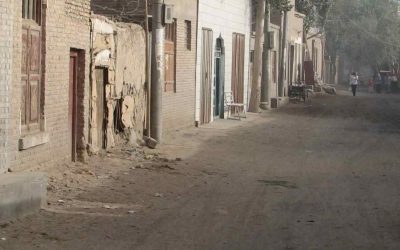
The Baoan, master sword makers in the Silk Road
The Baoan, master sword makers In the dry lands of Gansu province, at the foot of the Jishishan mountain, there are three villages inhabited by different people. At first glance, their life is the same as that of any other Muslim population in that vast region crossed...
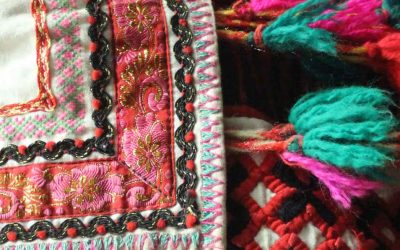
The goddess of the Sun of the Jingpo
The goddess of the Sun of the Jingpo The goddess of the Sun was in the sky when one day she realized that on Earth the situation of men had changed a great deal. When they were created, they were all equal, and without evil and they did not covet riches. The latest...
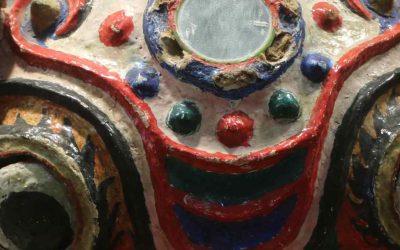
Funeral Masks of the Zhuang people in the Nationalities Museum of Kunming
Funeral Masks of the Zhuang people in nationalities Museum of Kunming Known as Longyawai Masks, they are funeral ceremony masks popular in the Zhuang communities of Wenshan Autonomous Prefecture, on the east of Yunnan Province. The masks are shaped as a lion, they are...
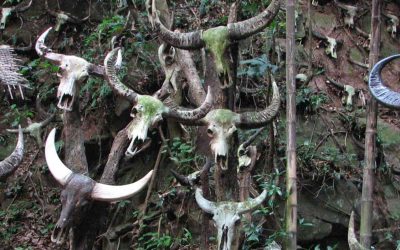
The creation of the world among the Wa of China
The creation of the world among the Wa of China As soon as the heaven was formed, it looked like the back of a toad, full of lumps and protrusions, it was very ugly. The god Li[i] extended his hands and was polishing without stopping. Nobody knows how many years he...
The Jinuo, descendants of the uncle
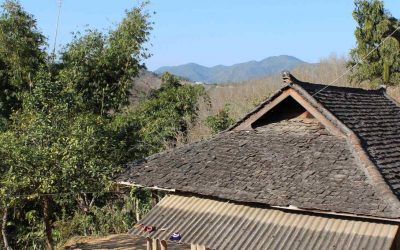
The Jinuo, descendants of the uncle The Jino, with a population of only 21.500 persons (in 2005) are one of the smallest minorities in China and the last to be officially recognized as such, as they were designated a national minority and granted the special rights...
The Blue Women of China of the Yao minority
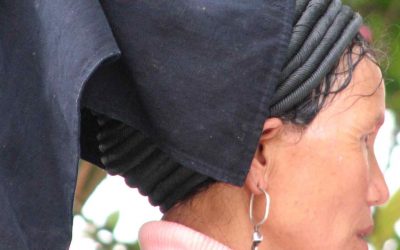
The Blue Women of China of the Yao minority Many people have heard of the Blue Men of the Sahara (the Tuareg), but few have heard of the Blue Women of China. And in fact among the women of the so-called Landian Yao or Landen Yao outside China, the production, dyeing...