

The Dong are one of the minorities of China with a large population. According to the census of the year 2000 their population was 3,000,000 people.
They live mainly in Guizhou Province (approximately 1,800,000 people), along a fringe of flat lands that cross the province from north to south. There is also a big Dong population in the southern part of neighboring Hunan Province (about 900,000), and more than 200,000 persons in Guangxi Zhuang Autonomous Region, and a few thousand in Hubei Province (Enshi Prefecture).
The Dong, as do most of the peoples related to them, live near the rivers or in hills generally not of great height. They mainly cultivate rice. They raise domestic animals, especially hens and pigs. The exploitation of the forests, which holds a special spiritual relationship with the Dong, is an activity of economic importance.
They refer to themselves as «Kam.»
It is generally considered that there are two quite different types of Dong, the Dong of the North and the Dong of the South.
There are important linguistic and cultural differences between them. In general those of the north have received more influences from mainstream Chinese culture, while those of the south better conserve the Dong traditions. The typical monuments of the Dong, such as Drum Towers, Bridges of Rain and Wind, and the Temples of the Goddess Mother Sama, are all characteristic of the Dong of the South.
Their language belongs to the Sino-Tibetan family, Dong Dai branch, Zhuang Dong sub-branch. It has two main dialects, understandably called the northern and southern dialects, whose speakers cannot understand each other easily. Each one of these dialects has in turn three clearly differentiated local sub-dialects.
After 1958 an alphabet was invented for their language, but it has not been widely used. Before 1958, they used Chinese characters adapted to their own language.
More posts on China ethnic groups
The Baoan, master sword makers in the Silk Road
The Baoan, master sword makers In the dry lands of Gansu province, at the foot of the Jishishan mountain, there are three villages inhabited by different people. At first glance, their life is the same as that of any other Muslim population in that vast region crossed...
The goddess of the Sun of the Jingpo
The goddess of the Sun of the Jingpo The goddess of the Sun was in the sky when one day she realized that on Earth the situation of men had changed a great deal. When they were created, they were all equal, and without evil and they did not covet riches. The latest...
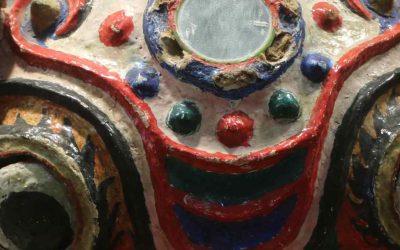
Funeral Masks of the Zhuang people in the Nationalities Museum of Kunming
Funeral Masks of the Zhuang people in nationalities Museum of Kunming Known as Longyawai Masks, they are funeral ceremony masks popular in the Zhuang communities of Wenshan Autonomous Prefecture, on the east of Yunnan Province. The masks are shaped as a lion, they are...
The creation of the world among the Wa of China
The creation of the world among the Wa of China As soon as the heaven was formed, it looked like the back of a toad, full of lumps and protrusions, it was very ugly. The god Li[i] extended his hands and was polishing without stopping. Nobody knows how many years he...
The Jinuo, descendants of the uncle
The Jinuo, descendants of the uncle The Jino, with a population of only 21.500 persons (in 2005) are one of the smallest minorities in China and the last to be officially recognized as such, as they were designated a national minority and granted the special rights...
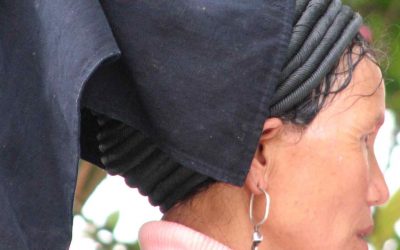
The Blue Women of China of the Yao minority
The Blue Women of China of the Yao minority Many people have heard of the Blue Men of the Sahara (the Tuareg), but few have heard of the Blue Women of China. And in fact among the women of the so-called Landian Yao or Landen Yao outside China, the production, dyeing...