


Funeral Masks of the Zhuang people in nationalities Museum of Kunming
Known as Longyawai Masks, they are funeral ceremony masks popular in the Zhuang communities of Wenshan Autonomous Prefecture, on the east of Yunnan Province.
The masks are shaped as a lion, they are in fact a cow head called «Longyawai», a gift given by the living to the dead, symbolizing that is a real cow for feeding them in the afterlife. The purpose is to let the dead live a carefree life in underworld with no concern of the human world.
These masks are made of paper pasted on a bamboo frame and are used together with two grim face masks.
Three people wear the three masks to dance on the day commemorating the dead and the following day for the funeral procession.

The museum exhibits three large masks, one with a lion’s head, one cow’s head and one with a shepherd’s head. They are very elaborate and of complex design, with huge mouths, eyes like round mirrors, and sometimes with fabrics hanging to cover the wearer. There are two smaller and simpler ones, one with the face of a monkey, used by the companions in the procession.
Yunnan Nationalities Museum, in Kunming, has one of the best collections of masks in China.
References:
–Masks in the Yunnan Nationalities Museum. Download the free book.


Last posts

Discovering the tiger and the shaman in Chinese characters.
Discovering the tiger and the shaman in Chinese characters. In Chinese skin is pifu (皮肤). In the character pi 皮, which means skin, one can still discover a hand flaying a skin. The character fu 肤, however, is a simplified character, showing us the radical of the...

Chinese character for «snake»
Chinese character for "snake” The Chinese character to represent the snake has undergone over the centuries a curious evolution that, although seen from the cultural perspective of the XXI century may seem strange, it will not be so much if we remember the symbolism...
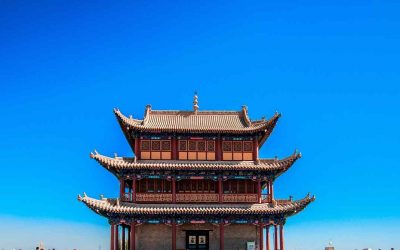
Jiayuguan Pass – the Great Wall on the Silk Road
Jiayuguan Pass - the Great Wall on the Silk Road Jiayuguan Pass or Jiayu Pass, as guan means pass in Chinese is one of the most remarkable monuments on the Silk Road and one of its most popular sights. Built at the end of the Great Wall, showing the desolation of the...