

Now is the time to ask him something about Taoism, I decided, and I poured out my questions. He looked up at me with his innocent, childish eyes, his smile gentle but, I thought, slightly ironical.
‘Take time, observe and learn,’ he said simply. ‘Words spoken in haste will not stick; a cup of water splashed into a parched field will do it no good. It is only a slow and gentle rain that will saturate the soil and produce life.’ He became silent ready to resume his work.
His rebuke abashed me. I saw what he meant. He probably thought I was an idle tourist, or worse, a young writer, who wanted to learn something about Taoism in an hour or so, and then write a smart article, boasting of the mysteries revealed to him. Seeing my obvious confusion, the old man relented. His face was all smiles now, but his eyes became thoughtful.
‘If you want to learn about the Eternal Tao, do not be casual and in a hurry. Don’t glean too much from too many books, for each book is full of opinions, prejudices and corruptions.
Read only one book and only one—our Old Master’s Taoteking, and then try to understand it, not by juggling the words and meanings, but intuitively, through your heart and spirit. Don’t ask too many questions, but patiently watch what we Taoists do, and perceive the hidden motives of our actions, and not that which is only for display.
Do not be guided so much by your intellect as by faith, love and your heart, which is another name for understanding and compassion. What you need is wisdom, and not knowledge; for if one has wisdom, knowledge will come naturally. Always remember that the Eternal Tao is Infinite Wisdom, Infinite Love and Infinite Simplicity.’ And with this the old man took up his pickaxe and resumed his hoeing of the bush.
From: Peter Goullart. The monastery of Jade Mountain. 1961
More posts on Chinese culture
Basic Geography of China
Basic Geography of China The People's Republic of China, with an area of more than 9,600,000 km2 is the third largest country on our planet, after Russia and Canada. The name China derives from the name given to it by its neighbors, because the Chinese call their own...

The religions of China
The religions of China Every people has the religion they inherit from their ancestors. This widely spread aphorism is truer in China than in other countries. Scholars say that the primitive religion of the Chinese, as of the peoples who lived near them, was the cult...

Notes on the Chinese theater
Notes on the Chinese theater The Chinese were extremely fond of theatrical performances. According to their traditions these originated in the time of Emperor Ming Huang of the Tang dynasty, later revered as the patron saint of actors, without whose help it is...

Taoist ceremony of repaying the debt
Taoist ceremony of repaying the debt Last week (on the 17th day of the fourth lunar month, 2018) took place at Zhenqing Temple (真庆观), the largest Taoist temple in Kunming and the best-preserved so far, the ceremony called "Repaying the Debt of Life". That ceremony is...

Classics of Filial Piety
Classics of Filial Piety Since the establishment of a Confucian society in the Han dynasty, some two thousand years ago, filial piety could be considered the central pillar around which Chinese society has been built. The behavior of each person towards his father...

Teahouse: A Drama by Lao She
In Brief: One of the best contemporary plays compels multiple reflections on hope and power, and perhaps that universal dream of living in a just society. A drama that unfolds in a limited space spanning half a century of Chinese history. In the three acts in which it...
More posts on China ethnic groups

Zhuang Folk Tales from Wuming
Zhuang Folk Tales from Wuming This book is a good sample of the folk literature of the Zhuang people living around Wuming County. Though formally separated in six chapters under the epigraphs of Traditional virtues, Bravery and Diligence, Cleverness and Creativity,...

Researches on the Mo culture of the Zhuang
Researches on the Mo culture of the Zhuang (壮族墨文化研究 Zhuang zu mo wenhua yanjiu). Huang Guiqiu。 Nationalities Press. Beijing. 2006. 321 pp Mo culture of the Zhuang refers to the Mo beliefs of the Zhuang and the Buyi nationalities; as their culture share a high...
Deciphering the culture of the fertility cults
Deciphering the culture of the fertility cults (生殖崇拜的文化解读 Shengzhi chongbai de wenhua jiedu). Liao Mingjun. Guangxi Peoples Press. Nanning, 2006 This book is a study of the fertility cults among the Chinese nationalities. Introducing the reader the different...

Pregnancy and Birth ceremonies among the Sha branch of the Zhuang
Pregnancy and Birth ceremonies among the Sha branch of the Zhuang The Sha are one of the branches of the Zhuang. They live in Yunnan province. The birth of a new child among them is surrounded by rituals that present significant differences from those of other...
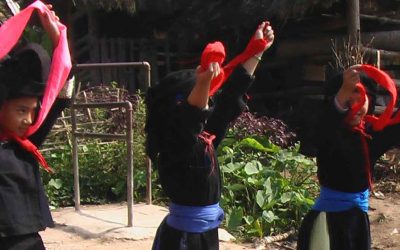
Some dances of the Zhuang people
Some dances of the Zhuang people The Zhuang have a number of dances. Originating from different periods of their history, it is thought that the older ones have a ritual origin, imitating the movements of their shamans during their religious ceremonies. In general...

Festivals of the Zhuang Nationality
Festivals of the Zhuang Nationality New Year The most important festival of the Zhuang year. Their celebration is similar to that of the local Chinese, although with some special characteristics. The children play their traditional games. In Wenshan County horse...