


Zhuang Nationality in Wenshan Prefecture
Wenshan Zhuang and Miao Autonomous Prefecture lies in the eastern section of Yunnan Province. Scarcely visited by local and international tourists with populations not considered of enough interest by the academic world, is one of the less known prefectures of Yunnan province.
Far from this superficial picture, Wenshan Prefecture possesses an ethnic diversity that makes it one of the most interesting places to travel. Wenshan Prefecture is mainly populated by Zhuang, Miao, Yi and Han nationalities. Any of these nationalities have well differentiated branches, we will introduce here the main branches of the Zhuang.
As is evident to every person that has traveled in the prefecture, there is a great variety of peoples included under the name Zhuang. In fact, among the suggestions to denominate Wenshan prefecture in 1957, three proposals were forwarded:
- To call it Wenshan Zhuang and Miao Autonomous Prefecture.
2. Wenshan Bu Nong, Bu Ya and Miao Autonomous Prefecture.
3. Wenshan Nong, Sha and Miao Autonomous Prefecture.
At the end, as everybody can guess, the first one was chosen. Maybe the reader is now wandering what means Bu Nong, Bu Ya, Nong, or Sha.
All these names are related to the three Zhuang branches that inhabit Wenshan Prefecture: Nong, Sha and Tu.
Most of the Zhuang of Wenshan belong to the Nong branch, about 600,000 people who constitute 50-60% of the total Zhuang population. They call themselves Bu Nong or Bu Xiong, and they can be found in every county of Wenshan. There are also interesting differences among them, which makes them to be known as:
– Nong Dau or Dau, in Guangnan County.
– Nong Yang or Yang in Xichou and Malipo counties.
– Nong Du or Du in Maguan County.
– Nong Dai or Dai in Guangnan County.
– Nong Chun in Maguan County.
The Sha branch has a population of around 300,000 people. They call themselves in different ways, a variation that is reflected in their dresses.
– Bu Yai
– Bu Ha.
– Bu Yue.
The third branch, the Tu, has a population of 100,000 people, and they call themselves Pu Dai. According to their headdress they are divided in:
– «Flat Headdress» Bu Dai or Tu.
– «Piled headdress» Bu Dai or Tu.
– «Pointed headdress» Bu Bai or Tu.
All those who have traveled to Wenshan, and have found that the ethnic clothes of the Zhuang were a labyrinthic issue, now can understand that they reflect an ethnic richness maybe not considered before.
This information has been extracted of the book:
Wang Minfu and Eric Johnson.- Zhuang Cultural and Linguistic Heritage, Yunnan Nationalities Publishing House. Kunming, 2008.
Image: Author’s photograph taken in 2005.


Last posts
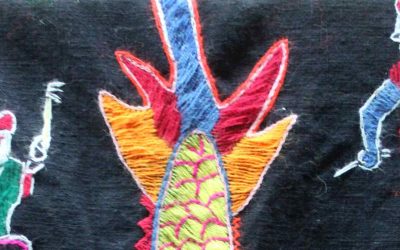
Interpretation of dreams among the Yao
Interpretation of dreams among the Yao The Yao have a complex system of dream interpretation, which, like other neighboring peoples, they divide into auspicious and unfortunate. For them, to dream of the sun setting behind a hill announced a calamity upon the parents....
Shadow – A Film by Zhang Yimou
Shadow - A Film by Zhang Yimou Zhang Yimou leads one of the most consistent and brilliant careers in the cinematography of China, and with The Shadow (Ying) he delights the viewer again with a beautiful and surprising story, based on a very original script, and that...

The Monastery of Sera – History and foundation
The Monastery of Sera - History and foundation Sera Monastery, located on the outskirts of Lhasa, is one of the largest monasteries in Tibet, and one of the most important centers of learning. Still today many young Tibetans come to the monastery to be trained in the...