


Zhangjiajie: The Sublime Landscape of the Film Avatar
Zhangjiajie is now one of my favorite destinations in China. Not only does it boast some of the country’s most spectacular landscapes, but in recent years it has continued to work on turning these places into settings for unique experiences. A visit to Zhangjiajie is becoming a must for travelers to China, and, importantly, everyone finds something around the city that meets their expectations. This is no coincidence, but the result of a sustained effort to satisfy visitors by creating new environments and regulating traffic at the most popular sites. Let us look at its three main attractions.
The Glass Bridge
The famous glass bridge in the Zhangjiajie Grand Canyon, for example, has significantly expanded the range of activities on offer. Reopened in 2023 after technical and safety upgrades, it remains a global benchmark for adventure tourism. At 430 meters long and suspended 300 meters above the ground, it was—and still is—the longest and highest glass suspension bridge in the world. But its evolution goes beyond record-breaking figures: today it forms part of an intelligently designed, sequential experience.
The simple act of visiting the bridge and crossing it—an ordeal for some travelers—has been complemented by the possibility of descending to the bottom of the gorge and walking for 3 km along a wooden walkway attached to the riverbank. With every step the scenery changes, and when there are few people, as we were lucky to experience in early September, one feels as if venturing into a tropical landscape.
The Descent to the River
The descent to the river itself already offers several kinds of adventure. You can go down on foot, combining the free elevator with a walk; the free elevator with a paid walk; or by zip line plus slide. While the zip line met our expectations, the slide leaves much to be desired. Some visitors take advantage of the vertical cliff to follow a via ferrata route—definitely not recommended for those who suffer from vertigo.
The National Park
Zhangjiajie National Park, with its magnificent stone formations made famous by the film Avatar, has multiplied the number of viewpoints from which this wonder can be admired.
The park’s towering stone pillars, declared a UNESCO World Heritage Site in 1992, achieved global fame in 2009 as the visual inspiration for the floating mountains of Pandora in Avatar. Rather than merely capitalizing on that fame with signs and merchandise, however, the authorities have worked to deepen the emotional connection between visitors and the landscape.
Today, the Yuanjiajie Scenic Area—the heart of the park and home to the peaks known as Avatar Hallelujah Mountain—offers multiple viewpoints with different perspectives. In addition, the park has limited daily capacity (maximum 50,000 people per day), assigns entry times to groups to eliminate waiting lines, and has removed internal combustion vehicles: all internal transport is electric or by low-noise cable car, reinforcing its commitment to regenerative tourism.
Tianmen Mountain
As for Tianmen Mountain, famous for the hole in its center, the new cable car and the road carved into the rock have completely transformed the visit. The Tianmen cable car is a world record and a cinematic experience. Opened in 2005 and modernized in 2023, it remains the longest mountain cable car in the world over natural terrain. Total length: 7,455 meters. Maximum height above the valley: 1,279 meters (equivalent to three 40-story skyscrapers). Journey time: 28 minutes—a trip that passes through three microclimates and offers constantly changing views: cultivated valleys → cloud forests → vertical cliffs → the mist-shrouded summit.
And although for many travelers the real milestone is the Path of the 999 Steps leading to the Gate of Heaven, I believe that the path that circles the mountain, with the breathtaking views it offers at every step, is truly the highlight of the journey.
That is why the Beijing-to-Chongqing itinerary, which has been so well received in recent years, will end in Zhangjiajie from 2026 onward.
About me: I have spent 30 years in China, much of the time traveling and studying this country’s culture. My most popular research focuses on Chinese characters (Chinese Characters: An Easy Learning Method Based on Their Etymology and Evolution), Matriarchy in China (there is a book with this title), and minority cultures (The Naxi of Southwest China).


Last posts

Zhang Yongzheng, the master of deluding reality
Zhang Yongzheng, the master of deluding reality Reality is an illusion, say Buddhist texts. And each of Zhang Yonggzheng's (Gansu, 1978) works plays with this concept to remind us again and again that there is no immutable reality but a fluid universe of forms that...

The book Hanzi for HSK 1-3 now available in Greek language
The book “Hanzi for HSK 1-3” now available in Greek language This April, the translation of my book Hanzi for HSK 1-3 has been published in the main digital bookstores in Greece. The Greek version of this book, from the pen of Stefanos Karampalis, has been one of...

Portrait of a Mandarin in 1800
Portrait of a Mandarin in 1800 This was the year in which a very interesting book was published, which through 60 portraits, tried to show some aspects of life in China to the western public. A book now in the public domain, from which we adapted "A Mandarin of...

The art of laying out gardens among the Chinese
The art of laying out gardens among the Chinese In the 1740s, William Chambers travelled on three trading voyages to China with the Swedish East India Company. He was the first European to study Chinese architecture methodically. In a book published in 1757, Designs...

The secret treasure of ancient Chinese art
The secret treasure of ancient Chinese art China has a fabulous artistic treasure hidden from the eyes of the public and specialists. It is her best kept treasure, because given the dispersion of its location, the difficulty of conservation and even evaluation and...
2,000-year-old paintings in a Chinese tomb
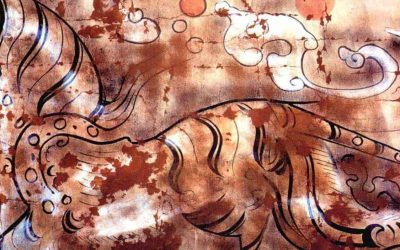
2,000-year-old paintings in a Chinese tomb It has been more than 10 years since the publication of The complete collection of murals unearthed in China, a dozen or so books describing with abundant full-color photographs the frescoes discovered in Chinese tombs....