


Unconventional languages used by the Jinuo
Not having a writing system, the Jino developed several systems of signs that covered communication in different situations: from the wooden gates in the mountain paths that warn of danger, to the daliu to expel demons, the wooden swords at the edges of the fields to mark one’s territory, the compositions of leaves to express their love, or the engraved boards and bamboos to record debts (Yu 2000: 82)
Engraved wooden or bamboo boards to record debts and economic interchanges reached a great complexity among them. In the past each Jino village had eight boards where a general account of the village grains, meat, horses, etc. were engraved. Every head of the family had at the head of his bed seven small boards where there were carved systems of small and big cuts to record their debts with the village (Yu 2000). After carving the big and small cuts on a board, it was separated into two parts that were kept respectively by the head of the village and the head of the family. Each account has one woodcut. Every time the money was handed in, they will make a mark on the woodcut. When the debt was completely paid they checked carefully to be sure that the two segments of the board fixed well and the board was then broken (MSD). To avoid confusion sometimes they added something related to the nature of the debt, such grains of rice or corn or cotton flowers to indicate that rice, corn or cotton was lent, carefully glued to the board to avoid the rats eating it.
Just before the modernizing reforms of the 1950s this system was so well developed that in every village one person had the duty to supervise this process and to update yearly the villagers’ accounts. Sometimes they also used real items to count, with grains of rice or corn representing units of a determined product or service, but it was a cumbersome method in which it was easy to make mistakes, and not as developed as the carving system (Jino 1999: 42).
Other symbols among the Jinuo
There is another set of symbols, some of them chosen by analogy, that have a definite meaning for the Jino people, such as the bronze bracelet that the husband gives his wife on the wedding, which symbolizes the permanency expected in the marriage; or chicken feathers, that are symbols of happiness as they announce the arrival of a new day. The crest of the chicken is a symbol of health for its healthy color. Hanging things in the earlobe is a symbol of laboriousness. “When a messenger delivered an urgent verbal message he carried a red pepper to show that it was an important matter, a piece of burning coal symbolizing a torch and a chicken feather to indicate urgency” (Zhi 1984: 92; Yu 2000:86).
There are other symbols with religious meaning used in their ceremonies or to keep away evil spirits, such as the daliu structures, or village gates, etc. Every village had a human gravure of wood to protect against fire and every 5 to 7 houses a smaller one, also supposed to protect against fire and theft.
The language of the leaves and flowers
Lovers used leaves letters to express their feelings, which were usually hung on the road or crossroads for the loved one. One of the most popular designs consisted of two bundles of leaves tied up together in human shape with a red string. The leaves can wither but the red string cannot, meaning that the love between these persons would never wither and will live forever (Yu 2000: 82).
References:
This is part of the first chapter of Pedro Ceinos-Arcones “China’s last but one matriarchy: the Jinuo of Yunnan”.
MSD. The Jinuo Ethnic group. www.msdchina.org/userfiles-/file/pdf/Jino.pdf. Access 24-10-2012.
Yu Xiqian. Jinuo zu wenhua lun (Discussions about the Jinuo culture). Yunnan Nationalities Press. Kunming. 2000.
Zhi Exiang. The Jinuos: China’s newest Nationality. In China Reconstructs. China’ Minority Nationalities. Beijing. 1984. Pp. 86-93.
You can also check Chinaviva.com for some posts about the Jinuo in Spanish language.


Last posts
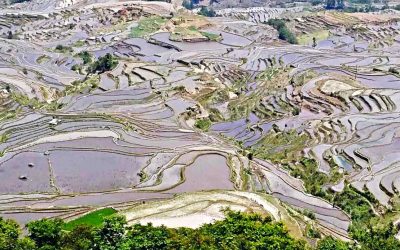
Yuanyang terraces, a wonder of man and nature
Yuanyang terraces, a wonder of man and nature In short: Man's centuries-old interaction with nature has created one of China's most beautiful landscapes and the country's most spectacular human work. The terraces of Yuanyang are one of the most spectacular human...

Xian, the ancient imperial capital
Xian, the ancient imperial capital In short: The ancient city inside the city wall retains a fascinating atmosphere. Its great monuments on the outskirts, such as the Terracotta Warriors, are among China's favorite attractions. Xian is undoubtedly one of the most...

Xin Ran – Sky Burial: An Epic Love Story of Tibet
Xin Ran - Sky Burial: An Epic Love Story of Tibet In Brief: A work full of exoticism that describes some interesting customs of the Tibetan nomads, but fails to convey emotions to the reader. Sky Burial: An Epic Love Story of Tibet is a novel set in the late 1950s. A...