


In Peter Goullart The Monastery of the Jade Mountain.
Unlike the Bible and the Koran. the Taoteking does not refer to the historical processes which led men, or rather a particular tribe among men, to the idea of One God. Neither does it describe in detail how this planet of ours came to possess plants, animals and men. According to the Taoteking the prima causa of existence’ is unknowable and hidden in a mystery more profound than all other mysteries. An ineffable rhythm had filled the Void and the interplay of its opposites, Yang and Yin, produced ‘Ten Thousand Things’.
The void
The Void of the Taoteking is not ‘nothing’ but, on the contrary, a ‘Mother’ of all seen and unseen ; the container of all possibilities, all forces, all dimensions of time and space and all spiritual and physical phenomena. It is the Godhead or Primordial Buddha of Ashvagosha, the great Patriarch and interpreter of Mahayana Buddhism, and the Brahma of Hinduism. All and everything issues from the Void, plays its appointed role and returns into the Void. This objectification of the Void in time and space or ‘being ‘—the Maya of Buddhism— is through and in Tao which is the Logos and Providence of the Christians and the Vishnu of the Hindus.
This Divine Current is above time, space and ‘existence’ itself but It fills, guides and nourishes all the Universe according to Its own laws. It is Infinite Love, Infinite Wisdom and Infinite Simplicity and contains all infinite potentialities. It is beyond all the attributes known to human mind and, therefore, Its nature is beyond all comprehension. It is the Divine Will in action.
Meaning of the Tao
Laotse called it Tao, a word which, he himself admitted, he chose for convenience sake. That of which he wrote has no name, being infinite and indescribable in earthly language. He had refrained from using the word ‘God ‘ because in Chinese connotation it always denotes some anthropomorphic deity, more often than not of a comparatively low rank. The word ‘Tao’ means ‘Way’ or ‘Road’ and it conveys a more sublime idea to the mystic who can thus imagine the Divine Spirit as a majestic road along which the world and our lives are moving.
Being a profound mystic and a shrewd observer of nature and men, Laotse evolved during his long life a definite concept of the laws according to which the Divine Tao acts in the world. He found out, undoubtedly from personal experience, that if man closely followed these laws, he would find a wonderful comfort and happiness in his identification with the Divine and that the Gates of Nirvana, the ultimate bliss and a key to the meaning of life, would be opened to him at the end of his peregrinations.
He penned his observations with such economy of words that the Taoteking reads more like an index of what Tao is and what man should do to merge himself into It rather than a book. Generally speaking, in my opinion, the Taoteking enunciates the Divine Laws as applicable to the whole Universe, while Christianity demonstrates the working of these laws as applied to the planet Earth.


Last posts

Kyzil Grottoes – Primitive Buddhist art on the Silk Road
The Kyzil Grottoes - Primitive Buddhist art on the Silk Road The Kizil Grottoes are located on the cliffs of Minya Dag Mountain facing the Muzhati River, 7 km southeast of Kizil Township, Baicheng County, and about forty-three kilometers west of present-day Kucha,...
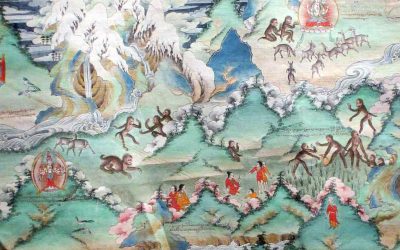
Tibetans, the people who descend from the monkey
Tibetans, the people who descend from the monkey According to an ancient myth, the Tibetans originated from the union of an ogress (raksasi) and a monkey. The monkey was sent by Avalokitesvara, Mother Buddha, to sow the seed of Buddhism in these lands. One day, an...
All you need to know about the ox in the Chinese horoscope
All you need to know about the ox in the Chinese horoscope The ox is a very beloved animal among the Chinese, despite its size, it is tame and peaceful, often in the villages, it is the youngest children who take it to the field to play, it rarely acquires the fierce...