

Taishan Mountain, life and death in Chinese culture, according to the work of Edouard Chavannes
Mountains are, in China, divinities. They are considered as nature powers who act in a conscious way and who can, therefore, be made favourable by sacrifices and touched by prayers; but these deities are of various importance: some are small local geniuses whose authority is exercised only on a small territory; others are majestic sovereigns who hold immense regions under their dependence. The most famous are five (1); they are: the Song Gao or Central Peak, the Taishan or Eastern Peak, the Hengshan or Southern Peak, the Huahan or Western Peak, the Hengshan or Northern Peak. Among these five mountains themselves, there is one that is even more famous than the other four; it is the Taishan or Eastern Peak (pp 3)
Folklore also teaches us that the mountains are the habitat of characters endowed with marvellous faculties; ╓6 fairies or gnomes have their frolics there. In China, under the influence of Taoism, these geniuses of the mountains were conceived as men freed from all the obstacles that weigh down and shelter our existence; they are the immortals, the blessed to whom one who feeds on marvellous jade utensils and who drink ambrosia can go, as the inscriptions on three mirrors from the time of the Han say (pp. 6).
But the mountain is not only the place where the celestial gods and the immortals appear; it is itself a divinity.
The general attributions of a mountain deity are of two kinds: on the one hand, in fact, it weighs by its mass on the whole surrounding territory and is like the principle of stability; it is the regulator which prevents the ground from becoming agitated and the rivers from overflowing; it puts obstacles in the way of earthquakes and floods. On the other hand, the clouds accumulate around the mountain top which seems to produce them and which deserves the Homeric epithet of «assembler of clouds» (pp. 8).
Many prayers from the Ming period show us that the Taishan is indeed invoked by virtue of these two kinds of attributions. In the spring, it is implored to promote the growth of grain; in the autumn, thanksgiving is offered to thank it for the harvest it has protected. It is asked to help men by its invisible and powerful action which distributes rain and good weather in the right proportions and allows the nourishing plants to reach maturity. In case of drought, it is quite natural to turn to it, because «to see that the rain comes to the ploughman in good time is the secret task for which it is responsible»; so when the rains are late, the ears of corn in the fields wither and the peasants begin to fear famine, the sovereign of mankind has recourse to the majestic Peak, who can and must put an end to this misfortune (pp. 8).
Similarly, in the event of an earthquake or flood, prayers appropriate to the circumstances remind the Taishan of his functions as ruler of an entire region and invite it to restore order (pp 9).
Taishan is the Peak of the East; in this capacity it presides over the East, that is to say, the origin of all life. Like the sun, so all existence begins on the eastern side. The yang principle, which makes the sap in the green plants spring forth, is concentrated on the Eastern Peak, from which emanates its invigorating fragrance (pp. 12).
At the same time as the Taishan carries in its side all future existences, it is, by a rather logical consequence, the receptacle where the lives that have come to an end go. From the first two centuries of our era, it was a widespread belief in China that when men died, their souls returned to the Taishan. In popular literature, there are a whole series of anecdotes that inform us about these kinds of Champs Elysées where the dead continue to speak and act as if they were alive; official positions are sought there, recommendations to influential people are very useful; it is another underground China that flourishes under the sacred mountain (pp. 13).
Since the Taishan gives rise to births and collects the dead, it has been concluded that it presides over the greater or lesser duration of human existence; it unites in itself the attributions of the three Fates, giving life, maintaining it and finally interrupting it. Around the year 100 A.D., a certain Hiu Siun, feeling seriously ill, went to the Taishan to ask to live. A poet of the third century A.D. wrote with melancholy: «My life is on its decline; the Eastern Peak has given me an appointment” (pp. 13).
The cult of the Taishan because this divinity presides over the souls of the dead. This is why in China one finds representations of the torments of the underworld in two kinds of Taoist temples, one being those of the god of the city (Chenghuang miao), the others being those of the Taishan (Dongyue miao). This again explains why, in these two kinds of temples, one often sees, suspended above one of the doors or against a wall, some enormous abacus; the presence of this calculating machine means that the divinity of the place has the mission of counting human actions and balancing good and evil (pp 16).
Historical texts tell us at various times and at great length about the famous feng and shan ceremonies that were performed at the top and bottom of the Taishan. The feng sacrifice was for Heaven; the shan sacrifice was for Earth. It is important to determine precisely what these rites were (pp. 16).
Imagen shi zhao via Flick.
Chavannes, Edouard. Le T’ai Chan. Essai de monographie d’un culte chinoise. Ernest Leroux. Paris. 1910.
More posts on Chinese culture
Violence and cannibalism in the Five Dynasties
l l Violence and cannibalism in the Five Dynasties When one begins to know the history of China, one concentrates its readings on its brilliant moments, on those great dynasties that expanded the territory, recreated surprising cultural forms and became the greatest...

DRAMATIC ART IN CHINA AT THE END OF THE DYNASTIC REGIME
oyaaDuring a break in my studies, the afternoon of Christmas Eve I was looking through a cabinet in which I have some somewhat old books bought on various occasions at flea markets in Beijing and Shanghai. After running into Lewis Morgan's "Ancient Society" and taking...
The value of the Taotejing, the sacred book of the Taoists
In Peter Goullart The Monastery of the Jade Mountain. Unlike the Bible and the Koran. the Taoteking does not refer to the historical processes which led men, or rather a particular tribe among men, to the idea of One God. Neither does it describe in detail how this...
The path to Nirvana in the Kunming Dharani Pillar
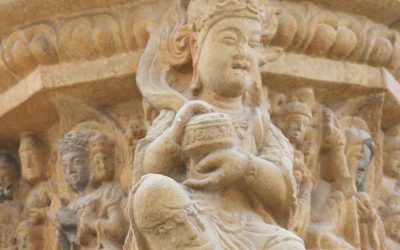
The path to Nirvana in the Kunming Dharani Pillar The main courtyard of the Kunming Municipal Museum houses one of the most original art-works from the time of the Dali Kingdom (937-1253 CE) in Yunnan. It is called the Dharani Pillar of the Dizang Temple. It is a...
Legends of the Mother Goddess: Intro
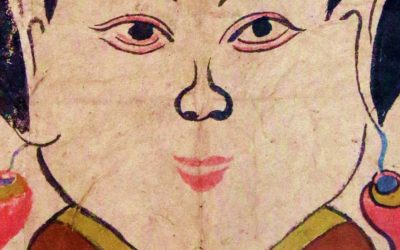
From Leyendas de la Diosa Madre. Pedro Ceinos Arcones. Miraguano, 2007. Anyone who approaches the literature of the minorities of Southern China will discover numerous works where the leading role is played by a female goddess or deity. Whether dedicated to the...
Buddha as a true man: a different tale
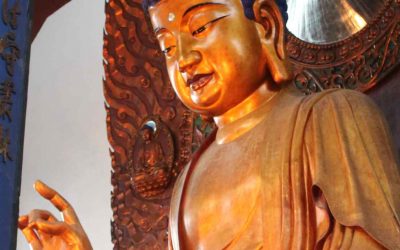
In the fourth chapter of India in the Chinese Imagination: Myth, Religion, and Thought (edited by John Kieschnick and Meir Shahar, University of Pennsylvania Press, 2014), Nobuyoshi Yamabe contributes an article (Indian Myth Transformed in a Chinese Apocryphal Text:...
More posts on China ethnic groups
No se encontraron resultados
La página solicitada no pudo encontrarse. Trate de perfeccionar su búsqueda o utilice la navegación para localizar la entrada.