


The five secret temples of the lamas in Lijiang
Religions of Lijiang
Although the city of Lijiang is known primarily for the Dongba religion practiced by the traditional shamans of the Naxi, also called Dongba, who with their rituals administered the religious and medical needs of the people, the presence of Chinese religions is also important among its population, having survived numerous samples of these cults, such as the temples to Wenchang that relate them to the imperial religion, and especially with Buddhism. And in fact, the Mu dynasty kings of Lijiang carried out an intense construction activity of Buddhist temples, most of them with magnificent decorations, of which only a few samples have survived.

Puji si (temple) near Lijiang. It belongs to the Karmapa school of Lamaism.
The Karmapa Lamas in Lijiang
Less well known is the presence of Tibetan monks in Lijiang. Most belonged to the Karmapa (or red-capped) school, which was the most powerful Tibetan school from the end of the Yuan dynasty in the 14th to the Qing dynasty in the 17th century. Possibly its arrival in Lijiang is related to the alliance of the Gelupta school (of the yellow caps) with the Mongols, who from the beginning of the 16th century had a more intense presence in Lhasa, provoking the violent reaction of the other schools, among them the Karmapa.
With the outbreak of violence, some began to leave Central Tibet. As a result of this diaspora, the first Karmapa monastery was established in Lijiang. The Yufeng Temple, just a few kilometers from Baisha, the ritual center of the Mu Dynasty kings. In the 18th century the struggle intensified. For a time the Karmapa were able to recreate a Tibetan kingdom that ruled all of central Tibet without any foreign help. But the Gelupta were able to get help from the Mongols and the Karmapa were finally defeated.

Karmapa master in the Fuguo Temple, near Lijiang
Establishment of the Karmapa Temples
Many Karmapa monks and lamas fled Tibet and some settled in the vicinity of Lijiang, founding 4 other Lamaist temples: Puji Temple, perhaps now the most isolated, Wenfeng Temple, famous for its meditation caves, Fuguo Temple, almost rebuilt from the ashes with a magnificent size, and Zhiyun Temple, on the shores of Lake Lashi, which combines some ancient buildings with modern ones and is becoming the main center of Karmapa teaching outside Tibet.
These temples venerate the typical deities of Tibetan Buddhism, protectors and bodhisattvas, as well as the main masters of the Karmapa school, Nilopa, Marpa, Milarepa and others. All suffered severe destruction during the Cultural Revolution in 1966, but some still retain samples of their original paintings, which increases the interest in seeing them. All are off the beaten tourist track, so you can visit them at your leisure, but must be reached by private vehicle (not very expensive), except Yufeng Temple (bus 6 stops at the door) and Zhiyun Temple (bus 31, with very irregular departures also stops at the door).
For the traveler visiting Yunnan without haste, a visit to one of these temples is highly recommended, especially if you are not going to visit Shangrila. Although Yufeng, because of its proximity to Baisha is the most accessible, I think the visit to Zhilin Monastery will be more rewarding.

Damaged painting of one of the Celestial Kings, on the main gate of Yufeng Temple.
About me: I have spent 30 years in China, much of the time traveling and studying this country’s culture. My most popular research focuses on Chinese characters (Chinese Characters: An Easy Learning Method Based on Their Etymology and Evolution), Matriarchy in China (there is a book with this title), and minority cultures (The Naxi of Southwest China). In my travels, I have specialized in Yunnan, Tibet, the Silk Road, and other lesser-known places. Feel free to write to me if you’re planning a trip to China. The travel agency I collaborate with offers excellent service at an unbeatable price. You’ll find my email below.


Last posts

Chinese character for «snake»
Chinese character for "snake” The Chinese character to represent the snake has undergone over the centuries a curious evolution that, although seen from the cultural perspective of the XXI century may seem strange, it will not be so much if we remember the symbolism...
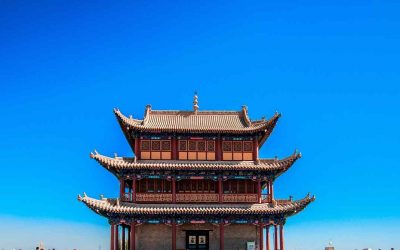
Jiayuguan Pass – the Great Wall on the Silk Road
Jiayuguan Pass - the Great Wall on the Silk Road Jiayuguan Pass or Jiayu Pass, as guan means pass in Chinese is one of the most remarkable monuments on the Silk Road and one of its most popular sights. Built at the end of the Great Wall, showing the desolation of the...

Springtime in a Small Town: The best film in China’s history
Springtime in a Small Town: The best film in China's history All the rankings made in recent years, place a film, unknown to the general public, as the best film in China. It is called "Springtime in a Small Town" and was directed by Fei Mu in 1948. I had been wanting...