


Suicide Caused by the Sale of Wives in Late Imperial China
During the Qing dynasty, family relations were a constant cause of suicide, especially for women. Many of the distinctive features of Chinese marriage pushed women toward suicide, one of the most lethal being the husband’s legal ability to sell his wife. In the Qing period, the sale of women and children was illegal, although it was permitted under certain circumstances.
Circumstances under which a wife could be sold
A husband could sell his wife if she had committed adultery, attempted to run away, agreed to be sold as a servant to another household, or if he himself was ill, disabled, or living in extreme poverty. We should remember that, having entered marriage without their feelings being taken into account, in some cases sale could offer women an opportunity to improve their situation, even allowing them to escape into a new life with a partner of their own choosing. In other cases, the fear of being sold kept them in a state of constant anxiety and extreme insecurity, and among the poor there was often no clear distinction between marriage and the trafficking of women (Sommer 2015: 2).
A last resort in times of family ruin
Sometimes destitution and extreme poverty were so widespread that wives became the family’s last economic resource. Drought, war, tax increases, or epidemics plunged thousands of households into absolute misery, forcing husbands to sell their wives or daughters in order to survive.
The tragedy of Nie Yide
Because wives could only be sold under certain circumstances, many conflicts arose—tragedies that have come down to us in compilations of judicial cases. In 1774, in Hengyang County, Hunan, the brothers of the peasant Nie Yide forced him to sell his wife, Chang Shi, to compensate them for an accidental fire she had caused. Nie did not want to do so, but had no choice. Chang Shi also refused to be sold and fled to her father’s house. Her husband went to retrieve her and explained the situation to his father-in-law. The latter, believing that his daughter was living a miserable life and might be better off with a new husband, did not object. When Chang Shi was persuaded that her husband would not sell her, she returned home. But on the way she learned the truth and threw herself into a lake in an attempt to commit suicide. Rescued by her companions, she insisted that she would rather die than remarry. On arriving home, her husband and his brothers watched her all night to prevent her from fleeing or killing herself. The next day Chang Shi refused to eat and tried to escape. Her distraught husband begged his brothers to cancel the deal, but they insisted it was too late, as the money had already been received. They then tied Chang Shi to the bed and gagged her so that they could sleep. The next morning she was dead, having suffocated on the gag (Bodde and Morris 1967: 231).
In a Hunan case from 1830, Huang Dexiu sold his wife Chen Shi in marriage, causing her to hang herself. In another case from Anhui in 1831, Cao Yushu sold his wife to Wang Chaofu, who “used force to take her home and consummate the marriage,” after which she committed suicide “out of shame and indignation.” Both husbands were sentenced to one hundred strokes of the heavy bamboo and three years of penal servitude (Bodde and Morris 1967: 315).
Threats of suicide to force a sale
Threats of suicide could also be used by women to bring about their own sale. In an 1810 case from Linyu County, the peasant Ma Siliang sold his wife after she jumped into a well and had to be pulled out by neighbors. She was not injured (and made sure to jump in front of witnesses who would rescue her), but her dramatic gesture convinced her husband. She resented their poverty and constantly caused trouble, saying she wanted to marry another man so as not to suffer anymore (Bodde and Morris 1967: 217).
Wives sold into prostitution
Even worse were cases in which wives were sold into prostitution (not always openly declared) to criminal groups that managed to circumvent the law to maintain their businesses. Despite being punishable by law, this became very common in the eighteenth and nineteenth centuries. It could also serve as a punishment for women who failed to meet the expectations of their husbands or their families.
From Chapter 9 of The Culture of Suicide in China and the Fall of the Imperial Regime (La cultura del suicidio en China y la caída del régimen imperial)
About me: I have spent 30 years in China, much of the time traveling and studying this country’s culture. My most popular research focuses on Chinese characters (Chinese Characters: An Easy Learning Method Based on Their Etymology and Evolution), Matriarchy in China (there is a book with this title), and minority cultures (The Naxi of Southwest China).


Last posts
The bull and the political development of Neolithic China
The bull and the political development of Neolithic China Since the history of the penetration of domestic cattle in China goes parallel to that of the political concentration that gave rise to the first cities and later to the first states, that slow penetration of...
THE LION-DANCE AS RELIGIOUS DANCE
THE LION-DANCE AS RELIGIOUS DANCE The lion-dancers first appeared in China under the Tang dynasty (a.d. 618-906), and made their debut at the court of the kings of Tibet about the same time. The lion-dancer represents a form of the Indian mime or burlesque juggler,...

Taosi. The first capital of China
Taosi. The first capital of China Taosi is one of the most important archaeological discoveries in China in the past decades. Located in the southern part of Shanxi province, is possibly the first urban center emerged in China. The excavation of the ancient city of...
Who is this Goddess of Heaven scattering flowers?
Who is this Goddess of Heaven scattering flowers? When we arrive in a country with a culture as different as China, it is as if a fog blanket covers our eyes, allowing us only a blurred vision of everything around us. Then we recognize the characters in their writing...
Why do you must visit a Chinese park?
Why do you must visit a Chinese park? Many experienced travelers to China include in their programs the visit a neighborhood market thinking that the essence of the culture of the people is concentrated there. And they have their point, but not only in the market you...
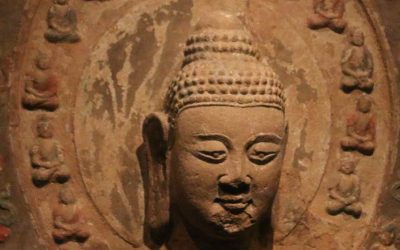
The most beautiful Buddhist sculpture in Beijing
The most beautiful Buddhist sculpture in Beijing It is the "Stone sculpture of the Sakyamuni Buddha with two guardians", which is in the Capital Museum of Beijing. It is dated in the Northern Wei Dynasty, in the 23rd year of the Emperor Taihe (499 AD) This statue is...