

From Leyendas de la Diosa Madre. Pedro Ceinos Arcones. Miraguano, 2007.
Anyone who approaches the literature of the minorities of Southern China will discover numerous works where the leading role is played by a female goddess or deity. Whether dedicated to the creation of the world (alone or in the company of a male deity), of the human race, or to the instruction of humanity or its ancestors in the basic notions of Neolithic culture (hunting, agriculture, stock breeding), female deities play a central role in the origin and development of humanity.
In recent times numerous works have been published defending the matriarchal character of a great part of the societies formerly established in the territory of Europe and the Near East, characterized by the cult of a goddess in her diverse manifestations: as a creator of the cosmos and of humanity, as an initiator in the secrets of existence and as a renewer of the world in an alternation of life and death that allows the continuity of everything that exists. This is an issue on which there has been no unanimity among the academic community and instead remains at the centre of a bitter debate with obvious political connotations.
Precisely because it is a subject in permanent debate, and because of the consequences it may have for the present life, I have considered it necessary to provide some facts related to the peoples of China.
My interest in the cultures of China’s minorities led me to learn about the existence of societies, such as the Moso, where inheritance is transmitted through the female line and social life is organized around matrilineal families; that of the Jino, who had female leaders until a few generations ago; that of the Yi, also with numerous female leaders; or that of the Lahu with their manifest gender equality. This series of events led me to wonder whether it would be possible to establish a cultural relationship, at least hypothetical, between the matriarchal societies of the ancient West, and those of the present, or of the near past documented in historical sources, of the Far East, in which women played the predominant role.
Going deeper into the culture of the indigenous peoples of China, I found numerous myths, legends, historical descriptions, rituals, and customs that suggest that in the more or less distant past, women occupied an outstanding social position. Among their myths, I was particularly struck by the many stories that highlight the creating or civilizing role of women, as well as those that describe in detail how women lost the dominant role in their societies.
As I discovered new myths that reinforced the role of women in China’s indigenous societies, my desire to find others like them in different social systems grew. As a result of this somewhat obsessive research, I ended up gathering together an interesting treasure trove of narratives that, encompassing the peoples inhabiting in different regions of China, make women the protagonists of history. Thus, what was initially only part of an effort to document the position of women in the societies of minorities, which should also include rituals, customs, and historical descriptions, took on such a volume that I felt it appropriate to translate and present these myths, with enormous interest in themselves, while continuing to investigate the traces of these ancient Chinese matriarchal societies in the minorities cultures of modern China.
By temporarily abandoning my research on Chinese matriarchy and replacing it with the translation of these myths, I realized that the interest in these narratives is multi-faceted: first, because they present the reader with a series of stories, most of which have never been translated into any Western language; second, because they make it possible to know some of the most common motives in the mythologies of the peoples of China (creation of the world, flooding, marriage of brothers, appearance of numerous suns, etc.); third, because they cover geographical regions so far away as to suggest the validity, at least for East Asia, of their subject matter; fourthly, due to their homogeneity in the positive treatment of the female deities which contrasts with other mythical narratives where they play a permanently negative role, and lastly because in a society which still stands on a framework that is tremendously hostile towards women, with tragic results on numerous occasions. Any work aimed at claiming their importance can become a drop in the great tide destined to reverse the present situation.
This work is not extensive, the narrations presented here can hardly be considered a small sample of the vast feminine mythology of the peoples of China. There are many myths that have been left out: either because they are too long, because they are too similar to some of the myths included, or because due to their complex symbolic language they would be difficult to understand for the general reader.
More posts on Chinese culture

To Serve the People, a satire by Yan Lianke
To Serve the People, a satire by Yan Lianke In Brief: A biting satire in which the small longings of each person are exposed as the inevitable substratum on which great ideals, such as "serving the people" are built. The censorship of a Chinese work is a powerful...
Chronicle of a Blood Merchant by Yu Hua
Chronicle of a Blood Merchant by Yu Hua One of the best Chinese novels of the 20th century. Without the apparent search for big ideas, it seduces the reader by its simplicity, and ends up entangling him in its plot. Chronicle of a blood seller, in reality, it is only...

The Grand Canal and the Great Wall
The Grand Canal and the Great Wall In Brief: A brief review showing some of the similarities between the two iconic works of Chinese history and culture, their goals, and their differences. As well as how they both ended up shaping this country. I have always been...

Duanwu Festival at a Taoist temple
Duanwu Festival at a Taoist temple Last Saturday I received news that during the Duanwu festival there would be a small ceremony at the Zhenqing Taoist temple. According to the information received throughout the day, there would be different cultural activities,...
The Canon of the Yellow Emperor
The Canon of the Yellow Emperor In Brief: The last great work of Chinese philosophy discovered so far, deserves to be known by all those interested in this country. Almost 50 years ago, in 1973, an important quantity of artistic objects was discovered in an ancient...
Super me – A beautiful adaptation of Lu Dongbin dream
Super me - A beautiful adaptation of Lu Dongbin dream In Brief: An adaptation of the myth of Taoist sage Lu Dong ping to the modern world. It manages to maintain a steady interest and combine Taoist teachings with some moralizing provided by the director. A failed...
More posts on China ethnic groups

Zhuang phallic ritual
Zhuang phallic ritual Zhuang minority has an interesting phallic ceremony. According to their legends, in antique times there was no communication between the two banks of the Hongshui River, women living on one bank of the river and men on the other. The god...
Zhuang Nationality in Wenshan Prefecture of Yunnan
Zhuang Nationality in Wenshan Prefecture Wenshan Zhuang and Miao Autonomous Prefecture lies in the eastern section of Yunnan Province. Scarcely visited by local and international tourists with populations not considered of enough interest by the academic world, is one...
History of the Zhuang nationality in China
History of the Zhuang nationality in China It is widely thought that the ancestors of the Zhuang were the ancient Yue. But there are no unanimity about the character, history and territory of these Yue. One people called “Yue” appears in the Chinese chronicles of the...

The Interpretation of the Dreams among the Hani
The Interpretation of the Dreams among the Hani As a general rule dream interpretation in China has followed a symbolic line, attributing to the memories of experiences lived during the dream a value related, sometimes not so clearly in a first analysis, to the values...
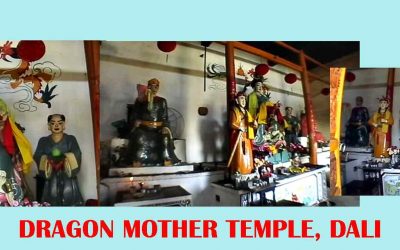
Temple to the Mother of the Dragon of the Bai
Temple to the Mother of the Dragon of the Bai Everyone who visits the ancient city of Dali goes to see the famous Three Pagodas, as it is one of the most famous monuments of the city and all of Yunnan, but very few know that right in the village next door, just 100...
Unconventional languages used by the Jinuo
Unconventional languages used by the Jinuo Not having a writing system, the Jino developed several systems of signs that covered communication in different situations: from the wooden gates in the mountain paths that warn of danger, to the daliu to expel demons, the...