


The World of Noodles
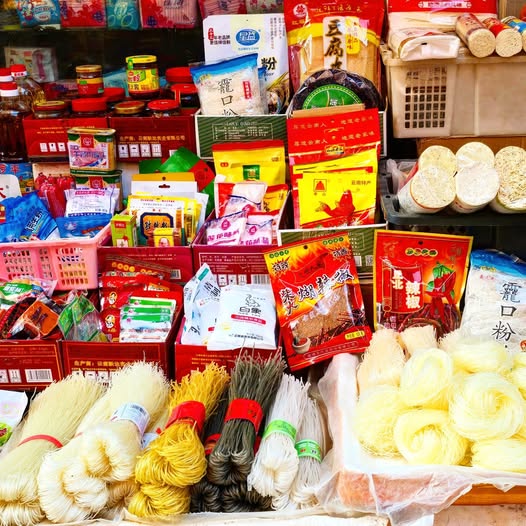
If the variety of wheat or rice noodles found in China is already enough to fill an entire book, an appendix should be dedicated to noodles made from other ingredients. It seems that any vegetable that can be turned into flour only needs a bit of water, some kneading, cutting into thin strips, and drying to become noodles. I suppose each of these steps requires a certain level of technique.
In the photo, a small shop in a market in downtown Kunming is displayed, and on its counter, one can distinguish noodles made from sweet potato, yam, mung bean, potato, and a few other varieties.
Oyster Vendor at a Night Market – Kunming, China
In recent years, China has become one of the world’s largest consumers of seafood. As a result, even in inland regions, it is quite common to find marine fish and shellfish, especially oysters, squid, octopus, and shrimp, usually from aquaculture farms.
In this image, we see the operator of a barbecue stand in a restaurant street in Kunming, a city in southwest China. It is eleven at night. The vendor is wearing a Muslim cap, and his apron bears the words «halal food.» In the background, a couple appears to be waiting for their meal, which we can see in the vendor’s hand. The young woman looks at him—perhaps hungry, or merely curious. Further back, other diners and the glowing sign of another restaurant complete the scene.

Giving Instructions
In China, it is quite common to see restaurant, café, and shop owners—sometimes even managers of massage parlors—gathering their staff at the entrance before starting the workday to give instructions on the tasks ahead. Typically, we see only half a dozen employees in uniform, and even that can be quite striking.
Today, while walking around, I came across this curious scene: sanitation workers in a central district of Kunming, all wearing their standard orange vests and yellow helmets, receiving instructions from their supervisor. I have passed this corner many times before but had never noticed them—yet it must be a daily routine.


Last posts
The Shuangdun Signs and the Origins of Chinese Writing
The Shuangdun Signs and the Origins of Chinese Writing When the origins of Chinese writing are discussed, attention almost always turns to the oracle bones of the Shang dynasty. Yet thousands of years before characters were carved onto turtle plastrons, surprisingly...

Zhangjiajie: The Sublime Landscape of the Film Avatar
Zhangjiajie: The Sublime Landscape of the Film Avatar Zhangjiajie is now one of my favorite destinations in China. Not only does it boast some of the country’s most spectacular landscapes, but in recent years it has continued to work on turning these places into...
Geckos and the “Mark of Chastity” in Imperial China: History, Symbolism, and Cultural Context
Geckos and the “Mark of Chastity” in Imperial China: History, Symbolism, and Cultural Context Across the long span of imperial Chinese history, the gecko occupied a surprisingly prominent place in discussions of female chastity, bodily integrity, and the regulation of...