


Funeral Masks of the Zhuang people in nationalities Museum of Kunming
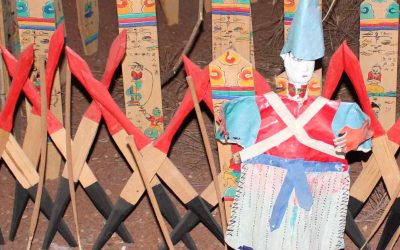
Known as Longyawai Masks, they are funeral ceremony masks popular in the Zhuang communities of Wenshan Autonomous Prefecture, on the east of Yunnan Province.
The masks are shaped as a lion, they are in fact a cow head called «Longyawai», a gift given by the living to the dead, symbolizing that is a real cow for feeding them in the afterlife. The purpose is to let the dead live a carefree life in underworld with no concern of the human world.
These masks are made of paper pasted on a bamboo frame and are used together with two grim face masks.
Three people wear the three masks to dance on the day commemorating the dead and the following day for the funeral procession.

The museum exhibits three large masks, one with a lion’s head, one cow’s head and one with a shepherd’s head. They are very elaborate and of complex design, with huge mouths, eyes like round mirrors, and sometimes with fabrics hanging to cover the wearer. There are two smaller and simpler ones, one with the face of a monkey, used by the companions in the procession.
Yunnan Nationalities Museum, in Kunming, has one of the best collections of masks in China.
References:
–Masks in the Yunnan Nationalities Museum. Download the free book.


Last posts

The monasteries of Tibet- the soul of the land
The monasteries of Tibet- the soul of the land One of the most charismatic aspects of Tibetan culture is its monasteries. Mention Tibet to anyone, at least in the West, and they will immediately associate that word with the monasteries and their monks. Those...
The Llubhu, women shamans of the Naxi
The Llubhu, women shamans of the Naxi The llubhu (also called sunyi) are the Naxi sorcerers or sorceresses. In ancient days they were always women, mediums who went into trances and claimed to see ghosts, the spirit of the deceased persons. They have the power of...
Sakya Monastery and its impressive art treasures
Sakya Monastery and its impressive art treasures Sakya Monastery is located 165 kilometers west of Shigatse, on the road to Tingri, and is a must-see for all travelers who can spare a little time to explore central Tibet, as well as those who end (or begin their...