


Chinese Herbal Medicine Shop in Weishan, Yunnan
China still maintains a strong tradition of using natural medicines, specifically herbs with medicinal properties that have been used for centuries. In addition to being present in the composition of many modern medications, some herbalists continue their traditional trade. Even in large cities, it is not uncommon to occasionally find herbalists selling fifteen or twenty products in their small stall or shop, each stored in a plastic bag. Usually, these products do not have labels, meaning that only an expert knows exactly what each medicine is.
Herbal medicine shop
In this shop, located in the ancient city of Weishan in Yunnan province, we find what could be described as the pinnacle of Chinese herbal medicine. Within this traditional house on the main street of the old town, we discover a unique display of medicinal herbs. On the left, some medicines are neatly arranged in white plastic bags, this time identified with small labels. Higher up, in a small nod to modern civilization, others are carefully placed in plastic bottles.
A unique shop in China
However, what makes this shop stand out from all the other similar stores and stalls across China is the sheer volume of herbs stored in the white and green sacks seen on the right side of the image. It is well known that each medicinal herb must be harvested at a specific time of the year and that many of these herbs are needed in large quantities to be therapeutically effective. The foresight of this traditional pharmacist creates a truly unique scene in the ancient city of Weishan.
Wonderful Weishan Old City
Weishan is one of the oldest cities in Yunnan province. Officially designated as an autonomous district for the Yi and Muslim communities within the Bai Autonomous Prefecture of Dali, Weishan boasts significant historical, artistic, and cultural attractions. Among them, the Ancient City, with thousands of well-preserved buildings, and Weibaoshan Mountain, located 10 km from the city, stand out as the most important Taoist mountain in Yunnan.
This is why we include this city in almost all of our itineraries in Yunnan.


Last posts
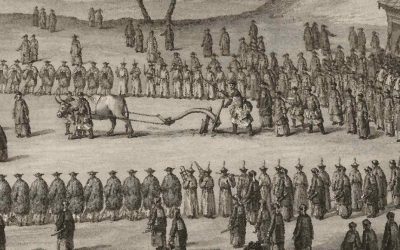
The ox and the ritual plow in springtime
The ox and the ritual plow in springtime Throughout the imperial era, every year the beginning of agricultural work was celebrated by a solemn ceremony called the Plowing Festival. "The emperor himself would take a yellow plow attached to a yellow ox (yellow was the...
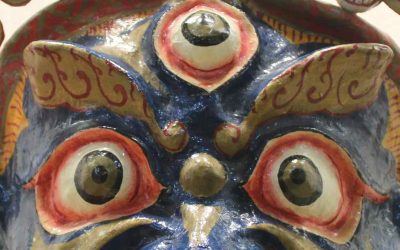
Mask of the Protector Palden Lhamo
Mask of the Protector Palden Lhamo Palden Lhamo is one of the main protector deities of Tibetan Buddhism. Among her many roles, she is the special protector of the city of Lhasa, the Gelugpa order of Tibetan Buddhism, and the Dalai Lamas of Tibet. She was invited to...
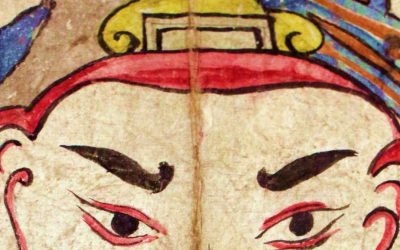
«Dujie» (Initiation Rite) Masks of the Yao people
"Dujie" (Initiation Rite) Masks of the Yao people Popular among the Yao people in Wenshan and Honghe Prefectures, the Dujie masks are used for the ceremonies of the boys' rites of passage. The ceremony, performed for boys that are about fourteen years...
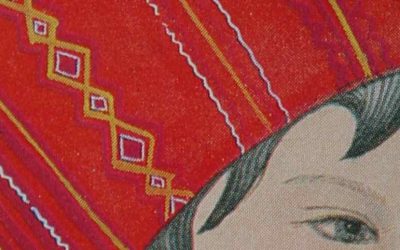
The headdress of the Jingpo women
The headdress of the Jingpo women The clothing style of the Jingpo people is rough and bold, It is possible that it reflects that past time when they were the masters of the frontier mountains, and caravans had to pay a tax to pass through their lands. Men of the...
Pictographic writing among the Evenki
Pictographic writing among the Evenki In Chi Zijian’s novel The Last Quarter of the Moon (English translation by Bruce Humes) there is a short story describing the creation of pictographs to write the Evenki language. “Shiban had two great loves: creating Evenki...
The bull and the political development of Neolithic China
The bull and the political development of Neolithic China Since the history of the penetration of domestic cattle in China goes parallel to that of the political concentration that gave rise to the first cities and later to the first states, that slow penetration of...