


Zhuang phallic ritual
Zhuang minority has an interesting phallic ceremony. According to their legends, in antique times there was no communication between the two banks of the Hongshui River, women living on one bank of the river and men on the other. The god Buluotou stretched out his big and long sex over the river, making a celestial bridge. Thanks to this bridge the people crossed the river, and they mated making the first families, and humanity propagated.
When the god become old and the bridge turned soft, he removed the bridge leaving two pubic hairs that turned in two ways, masculine and feminine, making a bridge of men and women, where the people met in joy.
Every year, in the days following the New Year Festival, local people gather in the two banks of Hongshui River to celebrate a festival honoring Buluotou’s sex. They sacrifice an ox and a cow to Buluotou, provided by the people living on the two banks of the river. Images of the sex of the god are hung everywhere, usually as a paper sail, that the wind can blow as in the penis of the god have an erection.
Zhuang people eat and drink, the young people sing love songs. During the festival, they honor also their goddess Miliujia, as they consider that both she and Buluotou together created human beings. In the last 30 years, the sacrifice of the ox and cow were stopped, but not the festival atmosphere and the singing gathering.


Last posts

To marry a goddess in Yunnan (Jinuo nationality)
Pedro Ceinos-Arcones. China's last but one matriarchy: The Jino of Yunnan. 2018 Jinuos’ main religious specialists are bailabao, mopei and zhalai or Blacksmith. The oldest man of the main clan in the village is called zhuoba or mother of the village; the oldest of the...
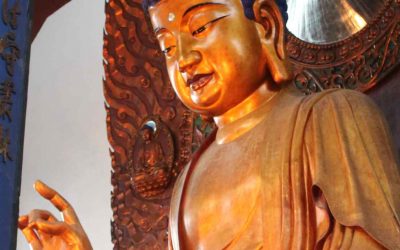
Buddha as a true man: a different tale
In the fourth chapter of India in the Chinese Imagination: Myth, Religion, and Thought (edited by John Kieschnick and Meir Shahar, University of Pennsylvania Press, 2014), Nobuyoshi Yamabe contributes an article (Indian Myth Transformed in a Chinese Apocryphal Text:...

Yu garden in Shanghai: Archetype of Chinese garden
Pedro Ceinos Arcones. Yu garden in Shanghai: Archetype of Chinese garden. Dancing Dragons Books. 2019. (Excerpts from the book) The Yu Garden is Shanghai's main monument and the one that best summarizes the city's history over the past few centuries. A private garden...