


Treating illnesses with a pillow from under a corpse
In a biography of Xu Sibo[1], a Daoist specialist in water therapy of the fifth century of our era[2], we read:
«There lived a matron who had been troubled with incurable constipation for many years, and that Sibo, making a diagnosis, said:
— This is a case of corpse-malady; fetch a pillow from under a corpse, seethe it, and let her consume it, and she will be cured.
On this, they went to an old grave, took a pillow out of it, one side of which was rotten, and the patient, having consumed it was forthwith better.
Later on, there was in Moling (modern-day Nanjing) one Zhang Jing, who had a swollen abdomen and a yellow complexion from his fifteenth year. The united attempts of physicians being unable to cure him, Sibo was consulted.
«Here we have a case of stony worms,» said he, «extremely difficult to cure; we must seethe a pillow of a corpse.»
Following his advice, they decocted such a pillow and gave the soup to the patient, who, with a copious discharge of diarrhea, excreted five pints of worms with heads as hard as stones, and then was better.
Afterward, he was consulted by Chen Shengyi, who suffered from pains in his eyes and often saw specters.
«Xié[3] influences have intruded into your liver,» said Sibo. «Try to get the pillow of a dead man, seethe it and consume the extract, and then bury the pillow again in its former place.»
The patient did so, and he too was cured.
Reason for the strange treatment
Now he was interviewed by Wang Yan.
«The three diseases were of different characters,» said this man, «and yet you cured them all in the same way with pillows from corpses; how was that?»
And the answer was:
«Corpse-malady is spectral influences in a suppressed and latent state, causing the patient to labor under constipation; if then he gets a coffin-pillow and consumes it, the hun soul and breath of the dead man fly over into him, so that those spectral influences can adhere to his body no longer; it is in this wise that corpse-malady is cured. The petrified worms were worms of long standing, which, as the medicines had stiffened within the patient, had become so hard that nothing in this world could expel them; therefore, something spectral was needed to cause them to loosen and thus render it possible to dispel them; and to this end, I ordered those people to boil for him a pillow taken from a coffin. And when xié influences enter the liver, they cause pains in the eyes, so that the patient sees mángliàng specters[4]. Something xié is then required to hook those influences; and as such, I used a coffin-pillow, which I thereupon ordered them to re-inter, because those influences would then be removed along with it.»
Chen Cangji and Li Shizhen carefully recorded this unusual medical method in their standard works. The first-named authority moreover wrote:
«Since pillows and mats placed under corpses also cure boils, these can be made to disappear by rubbing them fourteen times therewith, so that they come to a head.»
Comentary
And Li Shizhen adds:
«They cure spontaneous perspiration. Steal the border of the mat of a man who died in perspiration, burn it to ashes, boil these, wash the patient with the water, and he will become better. According to the Shanfanfan of Xie Shiqin, they cure corpse malady. If you have seen a corpse or heard cries of mourning, take some ravelings of a coffin-mat or some other things which have lain in a coffin and were thrown away in the road, and seethe them in three pints of water with a tiger’s claw three inches in length, until one pint remains; then consume this water, and good effect will follow immediately.»
Originally narrated in De Groot; J. J. M. The religious System of China. Vol 6. p. 1090 and ss. Brill, Leiden, 1910.
Notes
[1] The physician Xu Sibo in this story came from the prestigious Xu family, practitioners of medicine for eight generations.
[2] The History of the Southern Dynasties recounts a story in which a physician treated his patient according to an unusual method: Fang Boyu, a general at the Southern Qi (479–502) court, ingested scores of doses of a medicine to vitalize his body but enjoyed no benefit. Instead, he developed chills and had to wear thick clothes in summer. The physician Xu Sibo, upon diagnosis, announced that the general suffered from “dormant heat” (fure), which could be released by water. This therapy, the physician insisted, must be given in winter. They waited until the eleventh month of the year, when Xu asked two people to hold the general tight on a stone with his clothes off. They then poured a great amount of cold water on his head, so much that he lost consciousness. Despite pleas from the general’s family to stop the brutal treatment, Xu requested that yet more water be poured on the lifeless patient, who eventually started to move, with warm qi rising from his back. Soon he sat up, complaining about intolerable heat in his body and asking for a cold beverage. After drinking some cool water, he was cured. From then on, his body constantly emanated vital heat, and he became plump and strong (Liu, Yan. Healing with Poisons: Potent Medicines in Medieval China. Seattle: University of Washington Press, 2021.).
[3] In Chinese religion and medicine, xie (邪) refers to pathogenic or harmful influences, often translated as «evil» or «pathogenic factors.» Xie represents external or internal factors that disrupt the body’s balance, such as wind, cold, dampness, or heat, leading to illness. In a religious or spiritual context, xie can also denote malevolent forces or spirits that cause harm. The goal in both contexts is to expel or neutralize xie to restore harmony and health.
[4] The mángliàng (魍魉) specters are mythical creatures or spirits from Chinese folklore and mythology. They are often depicted as shadowy, ghostly beings or malevolent spirits that inhabit desolate or wild places, such as forests, mountains, or abandoned areas. In some traditions, they are considered minor demons or wandering spirits associated with chaos, confusion, or misfortune.
The term mángliàng can also refer to indistinct or elusive entities, reflecting their ambiguous and mysterious nature. Their role in folklore often serves to explain unexplained phenomena or to caution against venturing into dangerous or unknown territories.


Last posts
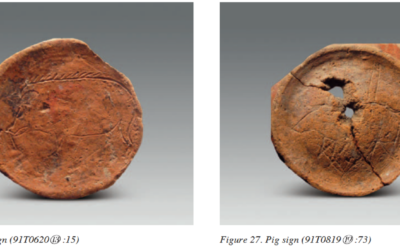
The Shuangdun Signs and the Origins of Chinese Writing
The Shuangdun Signs and the Origins of Chinese Writing When the origins of Chinese writing are discussed, attention almost always turns to the oracle bones of the Shang dynasty. Yet thousands of years before characters were carved onto turtle plastrons, surprisingly...
Zhangjiajie: The Sublime Landscape of the Film Avatar
Zhangjiajie: The Sublime Landscape of the Film Avatar Zhangjiajie is now one of my favorite destinations in China. Not only does it boast some of the country’s most spectacular landscapes, but in recent years it has continued to work on turning these places into...
Geckos and the “Mark of Chastity” in Imperial China: History, Symbolism, and Cultural Context
Geckos and the “Mark of Chastity” in Imperial China: History, Symbolism, and Cultural Context Across the long span of imperial Chinese history, the gecko occupied a surprisingly prominent place in discussions of female chastity, bodily integrity, and the regulation of...
Why It Is Necessary to Study Suicide in Chinese Culture
Why It Is Necessary to Study Suicide in Chinese Culture While drafting new chapters for my Brief History of China, cases of suicide kept appearing in the most diverse circumstances. Ministers and wives who allowed themselves to be buried alive to accompany kings to...
The true origin of the Great Wall
The true origin of the Great wall, as seen in Nicola Di Cosmo (The Origins of the Great Wall. Silk Road Journal. 1993). Generally speaking, the political discourse about foreigners in pre-imperial China tends to justify expansion and conquest, which is exactly what...
Tiger Leaping Gorge: a 3,000-meter drop into the Yangtze River
Tiger Leaping Gorge: a 3,000-meter drop into the Yangtze River The Yangtze River is the longest river in China and, at 6,300 km, the third longest in the world. It is China’s vital artery, flowing from its source on the Tibetan Plateau across the country’s central...