


The Wenzi Begins: Echoes from a Forgotten Taoist Voice
The Wenzi (文子) is an ancient Daoist text attributed to a disciple of Laozi. Although its authenticity has been debated throughout history, its content clearly reflects the Daoist worldview and its influence on the natural order, politics, and everyday life. This opening passage of the work, deeply poetic and philosophical, expresses the ineffable nature of the Dao and its power to generate and harmonize all aspects of the universe. Through imagery evoking primordial chaos, non-action, and the unity of opposites, the text invites an intuitive and vital understanding of the world. Here we present a modern translation intended for contemporary readers.
Laozi said:
“There is a thing, born from chaos, before Heaven and Earth. It has the semblance of form but no shape. Deep, dark, silent, still, without sound. I force myself to give it a name: I call it Dao.
Dao is so high it cannot be reached, so deep it cannot be fathomed. It enfolds Heaven and Earth, receives form from the formless, flows endlessly yet never fills. Murky, it slowly clears through stillness. It can be applied without end, without regard to morning or evening.
Its appearance does not fill a handful, but when constrained, it stretches; when hidden, it shines; when soft, it becomes strong. It contains the yin and exhales the yang, and from it emerge the three celestial lights.
Mountains are tall because of it, abysses deep because of it, beasts run, birds fly, the qilin roams and the phoenix soars, and the stars and the calendar move by its law. From death it draws life, from lowliness it takes nobility, from withdrawal it brings precedence.
In ancient times, the Three Emperors attained the unity of Dao and stood at the center. Their spirit moved and transformed, embracing all directions. Thus, they moved with Heaven and Earth in perfect harmony: cycles turned without end, waters flowed without rest, things were joined from beginning to end. Wind stirred, clouds rose, thunder sounded, and rain fell — all responding without exhaustion. All that is carved and polished returns to simplicity.
To act without acting aligns with life and death. To speak without striving leads to virtue. Serenity and joy without pride bring harmony. A thousand differences all find their ease in life.
Dao harmonizes yin and yang, regulates the four seasons, balances the five elements, nourishes grasses and trees, seeps into metals and stones. Birds and beasts grow great, their hair and feathers glossy. Bird eggs do not rot, beast embryos do not die. Fathers do not mourn sons, brothers do not grieve for brothers. Children are not orphaned, women are not widowed. No rainbows are seen, no thieves appear. These are the fruits of virtue.
The Way of the Great Constant brings forth all things without possessing them, completes their transformation without controlling them. All beings rely on it to live, yet do not know its virtue. They rely on it to die, yet cannot resent it. What is stored and accumulated does not lead to wealth. What is given and received does not lead to poverty.
Suddenly, indistinctly, it cannot be represented. Faintly, swiftly, it is inexhaustible in use. Deep and obscure, it responds to transformation without form. It moves forth, it flows freely, never moves in vain. It embraces both firm and yielding, rises and bows with yin and yang.”
Original text: https://ctext.org/wenzi/dao-yuan
About me: I have spent 30 years in China, much of the time traveling and studying this country’s culture. My most popular research focuses on Chinese characters (Chinese Characters: An Easy Learning Method Based on Their Etymology and Evolution), Matriarchy in China (there is a book with this title), and minority cultures (The Naxi of Southwest China). In my travels, I have specialized in Yunnan, Tibet, the Silk Road, and other lesser-known places. Feel free to write to me if you’re planning a trip to China. The agency I collaborate with offers excellent service at an unbeatable price. You’ll find my email below.


Last posts
Parnashavari: The Tibetan Goddess of Medicine
Parnashavari: The Tibetan Goddess of Medicine Within the complex symbolism of Tibetan deities and protectors, I like to look for distinctive details that allow us to identify a figure the moment we see them in a temple. One of the goddesses who makes this task...
The Smallpox Goddess (Doushen)
The Smallpox Goddess (Doushen) The Smallpox Goddess (Doushen 痘神) is part of a group of goddesses whose primary role was the protection of children. In the final years of the imperial era, they operated under the authority of Bixia Yuanjun, the daughter of the Emperor...
The Solution to the West’s Suicide Epidemic Can Be Found in the Culture of a Himalayan People
The Solution to the West’s Suicide Epidemic Can Be Found in the Culture of a Himalayan People In recent years, the number of suicides among young people has skyrocketed. In some countries, such as Spain, suicides have already surpassed traffic accidents as the leading...
Drak Yerpa: The Tibetan Cliffs of Meditation
Drak Yerpa: The Tibetan Cliffs of Meditation A visit to the cliffs of Drak Yerpa, about 30 kilometers from Lhasa, not only offers a glimpse of the beauty of the Tibetan landscape and some rural settlements near the capital, but also gives us the chance to explore one...

Great Taoist magician Liu Zheng
Great Taoist magician Liu Zheng Liu Zheng was a native of Pei[1]. Endowed with extraordinary talent and vast learning, he left no branch of knowledge unexplored. Profoundly reflecting on the human condition, he concluded that worldly honors and riches endure but a...
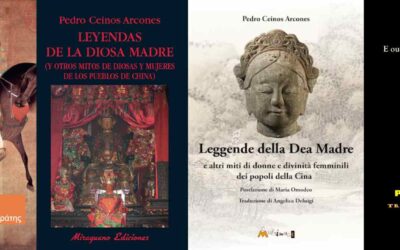
Legends of the Mother Goddess
Legends of the Mother Goddess I am pleased to share with all you that the Italian translation of my book Legends of the Mother Goddess (and Other Myths of Goddesses and Women from the Peoples of China) has now been published and is available for purchase. As many of...