

The sacred forests of the Dai: Protecting the ancestors – protecting nature.
Among the indigenous peoples that inhabit the south of China, there are a good number that have near their villages a small grove that they consider sacred. Usually they believe that this forest is the place that the protective spirits of the village inhabit; they maintain taboos in order to impede any activity that can deteriorate it. The Daile who live in the south of Yunnan Province, in Xishuangbanna Prefecture, in spite of being nominally Buddhists for more than 1000 years; still preserve vestiges of their indigenous religion. We see this in several customs, including the respect for these sacred groves. In fact, the Daile people say:
«Buddhism is for the future life, but the cult of the gods of the village is what can help in the present.»
Almost every Dai village has its small sacred forest, where the clan’s ancestors, who are the protective gods of the village, are believed to live. The animals of those forests, the plants, the earth and the water, everything is sacred and cannot be taken away. It is totally forbidden, not only to cut trees, but to take anything, to hunt, to cultivate the earth, and even to gather the fruits of the trees that are left to rot in nature. In fact, during most of the year, except on the two occasions when ceremonies in honor of the ancestors are carried out, people usually don’t even enter these forests. A study carried out by Mr. Gao Lishi (1) has calculated that in only the prefecture of Xishuangbanna, the sacred forests of the Dai people protect a total of 100,000 hectares, comprising approximately five percent of its total area. In his study he has concluded that due to their long interaction with the forces of nature, the Dai understand that without forests, there is no water, and without water they could not cultivate the rice on which they depend to survive, neither could they fish to supplement their diet. The prefecture of Xishuangbanna is unique in China. For it’s semi-tropical climate and abundance of flora and fauna, it enjoys special protection, as demonstrated by the declaration of numerous Nature Reserves and the development of a model of tourism that largely focuses on a respect for nature. Today almost one third of Xishuangbanna is protected forest. Recent studies have evaluated in a scientific way the purpose these sacred forests serve in the conservation of nature. Their conclusions show that they carry out several fundamental purposes: 1. Protection of biodiversity. Since inside these forests the number of vegetal and animal species is far larger than outside. 2. Protection of the soil and atmospheric humidity. 3. Oxygen production. 4. Protection of animals that fight in a natural way against agricultural plagues. As a quiet place which people rarely enter, these forests are a favorite nesting place for different species of birds, that can later play a crucial role in the natural control of plagues. 5. Natural protection against tempests, fires and climatic changes. 6. Protection of the culture and traditions of the Dai. We see once again that indigenous knowledge, so often underestimated by the national majorities, has usually evolved through a long interaction with nature, and the desire to protect it arises from a belief that to protect nature is to protect their own lives. It is interesting to observe how the majorities are now realizing that modern exploitation of the resources of many minority regions cannot be successful if the indigenous traditions of these areas are not borne in mind. This is because the local peoples have long known how to appropriately use and conserve these lands, as pioneers of what is now referred to as sustainable development. (1) Gao Lishi. – Dai zu «longlin» chongbai dui shengdai gongxian huanbao (Contribution of the sacred forests of the Dai to the protection of nature). In «Dai zu wenhua lun» (Discussions about Dai culture) Yunnan Nationalities Press. Kunming. 2000

More posts on China ethnic groups

Zhuang phallic ritual
Zhuang phallic ritual Zhuang minority has an interesting phallic ceremony. According to their legends, in antique times there was no communication between the two banks of the Hongshui River, women living on one bank of the river and men on the other. The god...
Zhuang Nationality in Wenshan Prefecture of Yunnan
Zhuang Nationality in Wenshan Prefecture Wenshan Zhuang and Miao Autonomous Prefecture lies in the eastern section of Yunnan Province. Scarcely visited by local and international tourists with populations not considered of enough interest by the academic world, is one...
History of the Zhuang nationality in China
History of the Zhuang nationality in China It is widely thought that the ancestors of the Zhuang were the ancient Yue. But there are no unanimity about the character, history and territory of these Yue. One people called “Yue” appears in the Chinese chronicles of the...

The Interpretation of the Dreams among the Hani
The Interpretation of the Dreams among the Hani As a general rule dream interpretation in China has followed a symbolic line, attributing to the memories of experiences lived during the dream a value related, sometimes not so clearly in a first analysis, to the values...
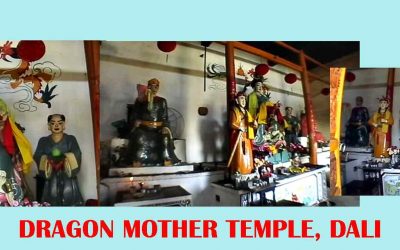
Temple to the Mother of the Dragon of the Bai
Temple to the Mother of the Dragon of the Bai Everyone who visits the ancient city of Dali goes to see the famous Three Pagodas, as it is one of the most famous monuments of the city and all of Yunnan, but very few know that right in the village next door, just 100...
Unconventional languages used by the Jinuo
Unconventional languages used by the Jinuo Not having a writing system, the Jino developed several systems of signs that covered communication in different situations: from the wooden gates in the mountain paths that warn of danger, to the daliu to expel demons, the...