


The Muslim Rebellion in Yunnan in 19th century.
This is the first English translation of Émile Rocher’s book on the Panthay Rebellion. Originally published in 1879 as La Province chinoise du Yunnan, is a valuable firsthand account of Yunnan during the mid-19th century, particularly focusing on the Panthay Rebellion (1856–1873), a major uprising of the Muslim Hui people against the Qing dynasty.
Rocher was a French diplomat and traveler who spent time in Yunnan and provided an outsider’s perspective on the rebellion and its consequences. His book is particularly notable for its descriptions of the political, social, and ethnic complexities of Yunnan, as well as its geographical and cultural observations.
The second volume of his book, which is mostly translated here, covers the Panthay Rebellion extensively, describing the rise and fall of the short-lived Dali Sultanate, the brutal suppression of the rebels by Qing forces, and the devastating impact on the local population. While not as well-known as later studies, Rocher’s account remains an important historical source, providing unique insights into the rebellion and the broader political and ethnic landscape of Yunnan in the 19th century.


Last posts

The sacred Taishan mountain
Taishan Mountain, life and death in Chinese culture, according to the work of Edouard Chavannes Mountains are, in China, divinities. They are considered as nature powers who act in a conscious way and who can, therefore, be made favourable by sacrifices and touched...

Family of characters 欠 qian
欠 qiàn – yawn; owe/ short of, lacking. The upper part evolved from the pictogram of an open mouth. A person人with an open mouth is yawning, or trying to compensate for the lack of air. 欠缺 qiànquē – lack/ be deficient of (lack + lack) 欠债 qiànzhài – owe a debt...
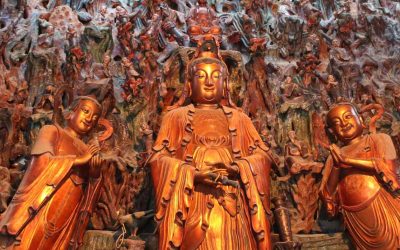
The Temple of the Soul Retreat in Hangzhou In 1930s
On the left side was a densely wooded rocky hill. Its steep slope was carved into fantastic figures of unicorns, leogryphs and other mythological animals, and statues of gods and saints. They had been fashioned out of rock by the monks more than fifteen centuries ago....