


The worship of the Local Lords (benzhu) is the most characteristic of the Bai people. Their religious life revolves around the Benzhu temple of each village, as each village venerates a local lord, sometimes a historical figure who sacrificed for the people. In other cases, it is the person who established the village, having mastered the local spirits or reached an agreement with them to allow people to live there. Their worship renews the right to inhabit the place for the descendants of the village founder. As their mythical history is continually recalled in the most solemn celebrations, a mythology unique to each locality has emerged. Their statue is kept in the temple, along with those of other popular deities, wealth deities, and motherhood deities, etc.
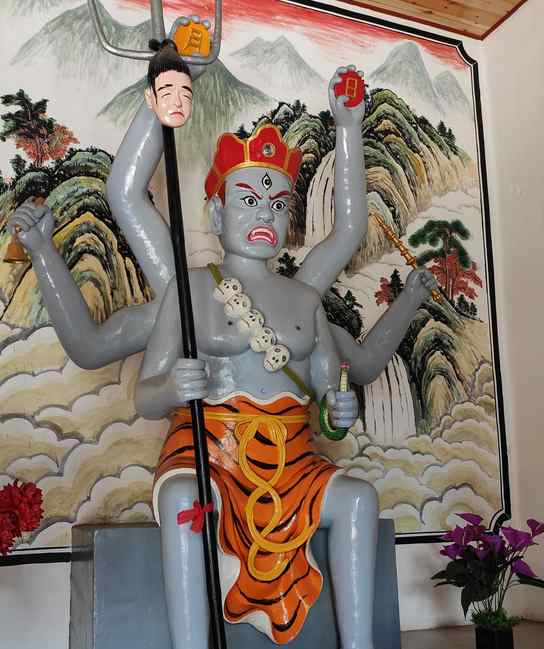
An infernal deity in the Benzhu Temple of Xizhou townshio, near Dali Old City.
Each village has its god, who protects the people and their livestock, prevents people from suffering illnesses, and controls the rain, thereby bringing peace and prosperity to the village people, so they are revered in any significant event. This «community god» religion keeps alive the memory of numerous legends and mythical characters, as it could be said that the temple of each of the villages almost bordering the shore of Lake Erhai presents an example of very particular religious syncretism, original mythology, and unparalleled iconographic exuberance.
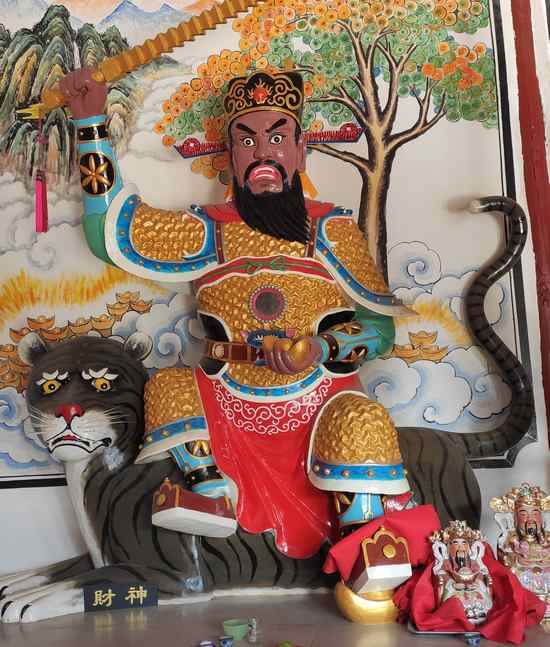
The God of Wealth Caishen in the Benzhu Temple of Xizhou Township, near Dali Old City.
These types of temples are related to the Tuzhu Temples still seen among the Yi of Weishan and which were erected in most districts of Yunnan centuries ago. Some researchers say that the first of them was founded by Xinuluo, the first king of Nanzhao, and that wherever Nanzhao expanded, these temples were established. Later, temples erected for the protective deities of indigenous villages (turen) were considered Tuzhu Temples.


Last posts
Unconventional languages used by the Jinuo
Unconventional languages used by the Jinuo Not having a writing system, the Jino developed several systems of signs that covered communication in different situations: from the wooden gates in the mountain paths that warn of danger, to the daliu to expel demons, the...
The Temple of Shen’an: Exemplary Writer and Traveler in Ming China
The Temple of Shen'an: Exemplary Writer and Traveler in Ming China Almost at the entrance to Kunming's famous West Mountains there is a small temple that goes unnoticed by most travelers. It certainly cannot compete in importance, beauty or decoration with the...
Ritual prostrations of Tibetan pilgrims
Ritual prostrations of Tibetan pilgrims The end of the path of any pilgrimage is a temple or mountain considered the abode of the gods. Reaching it is the culmination of the journey. At that moment the pilgrims, in spiritual bliss, pay homage to the gods in two ways:...