


The worship of the Local Lords (benzhu) is the most characteristic of the Bai people. Their religious life revolves around the Benzhu temple of each village, as each village venerates a local lord, sometimes a historical figure who sacrificed for the people. In other cases, it is the person who established the village, having mastered the local spirits or reached an agreement with them to allow people to live there. Their worship renews the right to inhabit the place for the descendants of the village founder. As their mythical history is continually recalled in the most solemn celebrations, a mythology unique to each locality has emerged. Their statue is kept in the temple, along with those of other popular deities, wealth deities, and motherhood deities, etc.
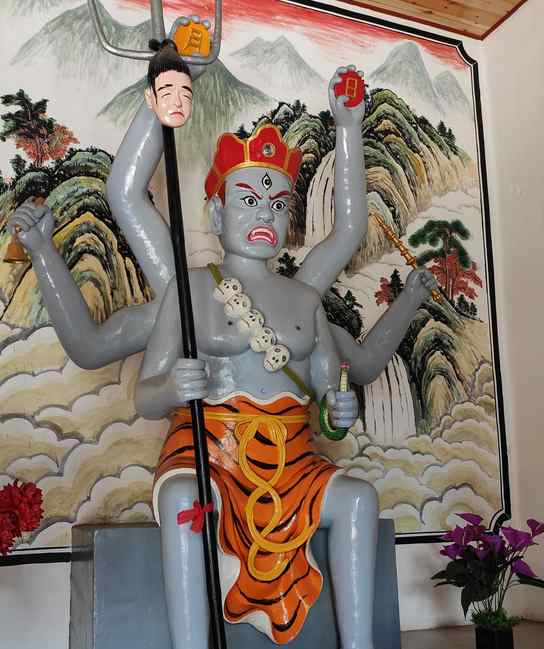
An infernal deity in the Benzhu Temple of Xizhou townshio, near Dali Old City.
Each village has its god, who protects the people and their livestock, prevents people from suffering illnesses, and controls the rain, thereby bringing peace and prosperity to the village people, so they are revered in any significant event. This «community god» religion keeps alive the memory of numerous legends and mythical characters, as it could be said that the temple of each of the villages almost bordering the shore of Lake Erhai presents an example of very particular religious syncretism, original mythology, and unparalleled iconographic exuberance.
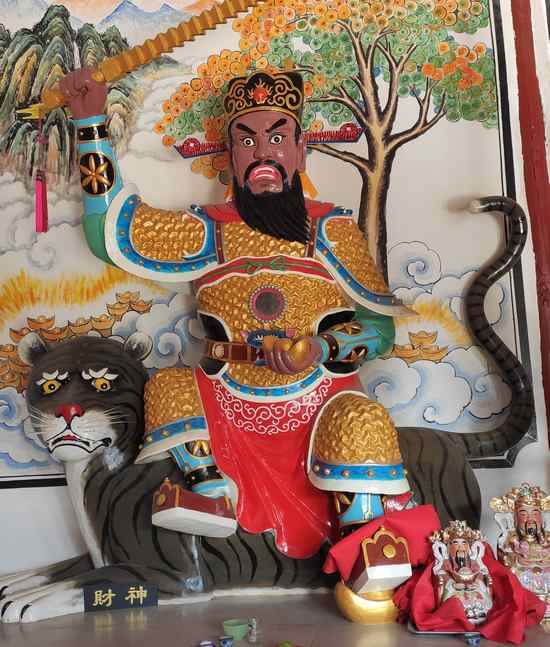
The God of Wealth Caishen in the Benzhu Temple of Xizhou Township, near Dali Old City.
These types of temples are related to the Tuzhu Temples still seen among the Yi of Weishan and which were erected in most districts of Yunnan centuries ago. Some researchers say that the first of them was founded by Xinuluo, the first king of Nanzhao, and that wherever Nanzhao expanded, these temples were established. Later, temples erected for the protective deities of indigenous villages (turen) were considered Tuzhu Temples.


Last posts

Classics of Filial Piety
Classics of Filial Piety Since the establishment of a Confucian society in the Han dynasty, some two thousand years ago, filial piety could be considered the central pillar around which Chinese society has been built. The behavior of each person towards his father...

Teahouse: A Drama by Lao She
In Brief: One of the best contemporary plays compels multiple reflections on hope and power, and perhaps that universal dream of living in a just society. A drama that unfolds in a limited space spanning half a century of Chinese history. In the three acts in which it...

To Serve the People, a satire by Yan Lianke
To Serve the People, a satire by Yan Lianke In Brief: A biting satire in which the small longings of each person are exposed as the inevitable substratum on which great ideals, such as "serving the people" are built. The censorship of a Chinese work is a powerful...