


The Flowery Miao in Zhaotong
As depicted by E. G. KEMP in The Face of China. New York. 1909.
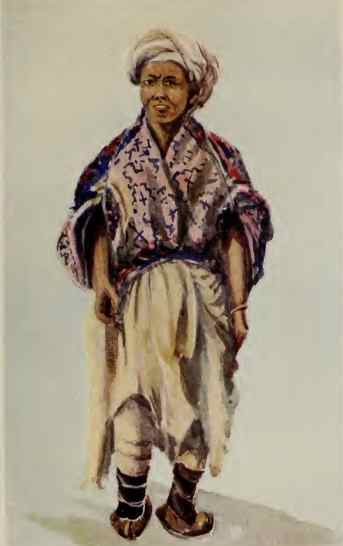
- The prefectural town of Zhaotong was reached after passing through a dull plain, across which a piercing wind was blowing, which is characteristic of this district. It is an interesting little place, and is much frequented by many of the Miao (aboriginal tribes) in their picturesque dress. The Hua Miaos (flowery Miao) are so called because of the colour of their dress, which is dyed blue and red by an ingenious method of stencilling the cloth, using beeswax to make the design. They are totally unlike the Chinese, the only point of similarity being the wearing of the pigtail by the men; but they have a religion and language of their own, and keep absolutely aloof from the Chinese.
Miao women
The women, when married, wear their hair erected into a horn, which sticks out from the side of the head; but as soon as they have children the horn is erected straight up from the top. They are very shy people, but as I was anxious to get a sketch of a woman, I got the missionary to persuade her to sing while I made a few notes. She was dressed in a pretty red and blue garment, with a large felt cape over it, and wore a full short petticoat of blue and white.
Both men and women wear gaiters and loose leather boots, and the men’s sleeves are looped up in a picturesque way as in the accompanying sketch. The women carry their babies slung on their backs.
Other tribes
- We were very sorry that lack of time prevented our making an excursion into the neighbouring district, which is inhabited by aboriginal tribes. The Wesleyan missionaries have been civilising some of these people, and one of their number has successfully reduced the Miao language to writing by an ingenious adaptation of Pitman’s shorthand system. The tribesmen are able to read and write in a few weeks, and have taken to writing letters to one another like ducks to water. There are [210] many different tribes among the mountains, some very- shy and unapproachable, and with curious customs of their own.
A race of the Manzas
A member of the mission described to us a curious race that takes place in Bábú land where the Manzas live, but which had never been visited before by European women. The course is strewn with the feathers of fowls, and the men wear very full, short, circular dark capes, and a sort of crest on their heads. Then they put their ponies at full gallop, and extend their arms so that they look like eagles with extended wings as they sweep round the course ventre a terre enveloped in a cloud of feathers and dust. Some of the tribes are very wild ; not infrequently the Lolos or Ibien, as they prefer to be called, kidnap the Chinese and make them pay a heavy ransom, so that little towers of refuge are built in this district.
The number of these aboriginal tribes is probably unknown to any one; we always heard conflicting accounts of them, and until recently no systematic attempt has been made to approach them. Hosie describes how difficult it was even to catch a glimpse of any of them when they were close beside the road, as they lurk in the bushes to try and see others, themselves unseen.


Last posts

Book – General introduction of the Culture of the Zhuang
Dai Guanglu and He Zhengting. The General introduction of the Culture of the Zhuang People. Yunnan Fine Arts Publishing House. Kunming, 2005. Though this book is not properly written in English, it has a two page English introduction to each of the twelve chapter it...

Two Thousand Zhuang Proverbs from China
Zhou Yanxian. Two Thousand Zhuang Proverbs from China with Annotations and Chinese and English Translation. 2017 Peter Lang Publishing, Inc., New York. 2016 If in other post I introduced a translation of the most solemn texts of the Zhuang Nationality, the myths...

Tai Cosmogonic Texts from Guangxi in Southern China
David Holm.- Recalling Lost souls: The Baeu Rodo Scriptures - Tai Cosmogonic Texts from Guangxi in Southern China. Bangkok, 2004. 344 pp. This is one of the most valuable books to know the myths and culture of the Zhuang. After an introduction to Zhuang culture and...