


The Discipline Paintings in Tibetan Temples
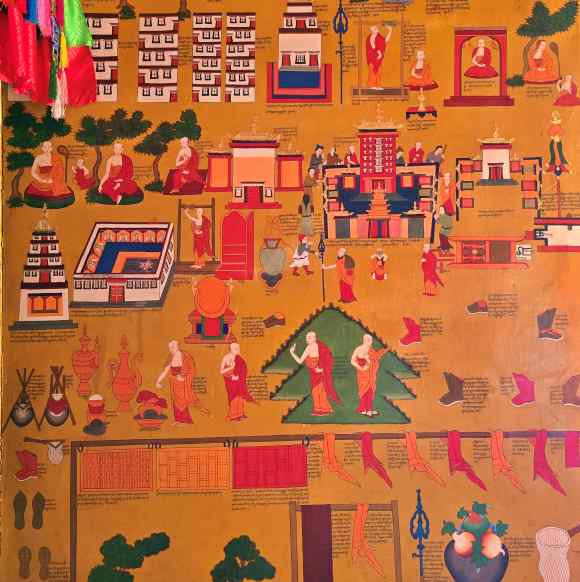
Among the paintings of deities, protectors, and other philosophical themes that usually decorate the entrance of a Tibetan Buddhist temple, some temples feature a very different kind of imagery. These are known as the “Keys of Discipline” or “Vinaya Keys.” They depict textiles, monastic robes, shoes, alms bowls, buildings, and, more generally, material objects rendered with the detachment of a commercial catalogue. In fact, they provide a graphic representation of the rules that govern monastic conduct.
These rules are clearly defined in a specific corpus of scriptures known as the Vinaya Piṭaka, which forms part of the Buddhist canon and must be memorized by all monks. It includes compulsory disciplinary regulations, internal judicial procedures, rituals of confession and expiation, and rules concerning dress, food, sexuality, property, and hierarchy. Its core text, the Prātimokṣa, contains 227 rules for monks and 311 for nuns, and is recited publicly every two weeks.
The Function of These Paintings
The purpose of these paintings is to show permitted actions, indicate prohibited ones, teach the correct use of objects, gestures, and spaces, and constantly remind monks of the ideal of proper bodily conduct. They can be grouped into the following categories:
- Rules on Movement and Bodily Posture
Figures of monks walking, standing, or sitting illustrate the correct way to move. One should not walk in a worldly manner, sway the body, gesture excessively, run, or move with unnecessary haste. Movement should be calm, with the gaze lowered, avoiding looking at women, markets, or public entertainments.
Proper sitting is also prescribed: one should not recline, cross the legs like a layperson, or adopt “decorative” or theatrical postures. - Rules on the Use and Placement of the Robe
The lower register, showing robes hung, folded, or laid out, is particularly explicit. Robes should never be placed directly on the ground. They must be dried in appropriate places, folded correctly, and worn properly. The monastic robe legally defines the monk, which is why these rules are so detailed. Another section regulates the type of footwear to be worn in different circumstances. - Rules Concerning Permitted Objects
These refer to the bowls, staffs, and utensils depicted. A monk is required to own only a single alms bowl, which must not be made of precious materials or be decorated, but rather simple and functional. The paintings also show the proper teapots used to serve tea to monks during prayers, and the cups from which it should be drunk. - Rules on Alms-Gathering and Religious Practice
These scenes indicate that alms should be requested in silence, without choosing specific houses or insisting on donations. Other figures are shown circumambulating a sacred building, while others meditate beneath a tree, illustrating the correct postures for these practices. - Rules on Architecture and Spatial Organization
Particularly striking are the rules concerning architecture and space. They define the ideal separation between monastic and lay areas, as well as the proper forms of monasteries, cloisters, altars, and stupas, clearly delineating each ritual space. - Rules on Hierarchy and Communal Conduct
Some paintings depict different monks and indicate their order of precedence, showing the correct way to approach a superior and emphasizing that one should never sit in a higher position than a senior monk.
As can be seen in the images, each of these aspects is accompanied by a specific explanation written in Tibetan next to the corresponding illustration.
In many monasteries, these paintings are located on the right-hand side of the entrance, while on the left are the Wheels of Life, which convey some of the most profound philosophical teachings of Buddhism. In this way, the two messages complement each other: correct conduct in every moment is presented as the necessary first step toward any spiritual ascent.
About me: I have spent 30 years in China, much of the time traveling and studying this country’s culture. My most popular research focuses on Chinese characters (Chinese Characters: An Easy Learning Method Based on Their Etymology and Evolution), Matriarchy in China (there is a book with this title), and minority cultures (The Naxi of Southwest China).


Last posts

The Horse God as One of the Most Popular Deities in China
The Horse God as One of the Most Popular Deities in China If a visitor goes to the Great Wall at Juyongguan, the section closest to Beijing and one of the most historically significant, and takes the time to explore the complex of structures carefully—a...
Geckos and the “Mark of Chastity” in Imperial China: History, Symbolism, and Cultural Context
Geckos and the “Mark of Chastity” in Imperial China: History, Symbolism, and Cultural Context Across the long span of imperial Chinese history, the gecko occupied a surprisingly prominent place in discussions of female chastity, bodily integrity, and the regulation of...
Why It Is Necessary to Study Suicide in Chinese Culture
Why It Is Necessary to Study Suicide in Chinese Culture While drafting new chapters for my Brief History of China, cases of suicide kept appearing in the most diverse circumstances. Ministers and wives who allowed themselves to be buried alive to accompany kings to...
The true origin of the Great Wall
The true origin of the Great wall, as seen in Nicola Di Cosmo (The Origins of the Great Wall. Silk Road Journal. 1993). Generally speaking, the political discourse about foreigners in pre-imperial China tends to justify expansion and conquest, which is exactly what...
Parnashavari: The Tibetan Goddess of Medicine
Parnashavari: The Tibetan Goddess of Medicine Within the complex symbolism of Tibetan deities and protectors, I like to look for distinctive details that allow us to identify a figure the moment we see them in a temple. One of the goddesses who makes this task...
The Smallpox Goddess (Doushen)
The Smallpox Goddess (Doushen) The Smallpox Goddess (Doushen 痘神) is part of a group of goddesses whose primary role was the protection of children. In the final years of the imperial era, they operated under the authority of Bixia Yuanjun, the daughter of the Emperor...