


The Beauty of Yamdrok Lake
Yamdrok Lake is one of the four most important sacred lakes in Tibet, the one closest to the capital and the most frequently visited. Fan-shaped and opening toward the south, it stretches about 130 km from east to west and 70 km from north to south, covering an area of 638 km². It is the largest lake in southern Tibet. Its depth varies, and it is surrounded by mountains; its shoreline curves into bays and inlets that help create ever-changing landscapes.
A Sacred Lake
Tibetans regard lakes as sacred, just like mountains, as they are believed to be the abodes of protective deities and are therefore endowed with spiritual powers. Yamdrok Lake is believed to possess divinatory powers, which has made it a frequent destination for pilgrims. It is venerated as a talisman and considered part of the vital spirit of the Tibetan people. It is said that if its waters were to dry up, Tibet would no longer be habitable.
On a peninsula extending into the lake stands Samding Monastery, the only Tibetan monastery headed by a female reincarnation. Although it is not a nunnery, its abbess leads a community of around thirty monks and nuns. The monastery is famous as the residence of Dorje Pakmo, the only female lama in Tibet.
A Must-See Destination
Most tour groups traveling to Tibet include a visit to this lake. Travelers with limited time can make a one-day excursion from Lhasa, although it is far more rewarding to follow the entire shoreline along the famous Route 318, on the stretch between Lhasa and Gyantse. Route 318 is one of China’s most renowned highways, a favorite among drivers and motorcyclists. It extends for 5,476 km, running from Shanghai to the Nepalese border.
Highlights
When departing from Lhasa, after crossing the Yarlung Zangbo River, the road gradually climbs through gentle curves that offer constantly changing views, with the river receding farther below. Before reaching the Kamba-la Pass at 4,797 meters, which gives access to the lake basin, there is a viewpoint with spectacular vistas. Local residents often gather there with impressive Tibetan mastiffs and yaks, allowing tourists to take photographs with them.
Soon the first views of the lake appear. Travelers are captivated by its clear blue waters, set against distant snow-covered mountains reflected on the lake’s surface, most notably the perpetually snow-capped Nojin Kangsang peak, rising to 7,191 meters. This landscape, with its subtle variations, accompanies the traveler for much of the route toward Gyantse.
Stops Along the Way
Along the route there are several scenic points where visitors can stop to take photographs, some also offering yaks for a “typical Tibetan” picture. Along the shore lie a few villages that are slowly changing, where people largely continue to lead traditional lives. The lake is also renowned as a habitat for numerous species of migratory birds, and its waters are home to several endemic fish species. Our Tibet itineraries always include a visit to this lake.
About me: I have spent 30 years in China, much of the time traveling and studying this country’s culture. My most popular research focuses on Chinese characters (Chinese Characters: An Easy Learning Method Based on Their Etymology and Evolution), Matriarchy in China (there is a book with this title), and minority cultures (The Naxi of Southwest China).


Last posts
Imperial Processions to the Temple of Heaven
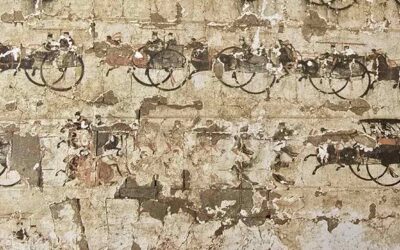
Imperial Processions to the Temple of Heaven Those who know China—even if only through a brief trip—and who have visited the Temple of Heaven in Beijing will surely have been fascinated by the sober beauty of its buildings. Yet, whether on a crowded day or during a...
Most Frequent Scenes from the Life of the Buddha in Tibetan Art
Most Frequent Scenes from the Life of the Buddha in Tibetan Art In fact, only a few moments are repeated very frequently in Tibetan paintings. In some versions there are eight—an auspicious number for Tibetans, corresponding to the Noble Eightfold Path and the eight...
The Dog as Psychopomp in China
The Dog as Psychopomp in China One of the oldest human beliefs was that after death there existed an immaterial part of the person—later called the soul or spirit—that did not disappear with the body. Its origin may lie in the “presence” of the dead in dreams,...
An ambitious project to rewrite history
An ambitious project to rewrite history. It is what we see in Lhamsuren Munkh-Erdene, The Nomadic Leviathan. A Critique of the Sinocentric Paradigm. Brill. Leiden. 2023. Now free to download in the publisher’s webpage. This book is a critique of a theoretical paradigm...
Why I devoted more than a year to researching suicide in Chinese culture
Why I devoted more than a year to researching suicide in Chinese culture In early November 2022 my friend, the psychiatrist Luz González Sánchez, told me that she was preparing a lecture on suicide. On the 8th of that same month, during a quiet moment, I made a brief...

The Tibetan Deity with a Horse Face
The Tibetan Deity with a Horse Face During my most recent journey to Tibet, someone pointed out to me in a temple a deity who bore a small horse upon his head. I knew that this protector is called Hayagriva, and that he is sometimes referred to as “Horse-Headed” or...