


Parnashavari: The Tibetan Goddess of Medicine
Within the complex symbolism of Tibetan deities and protectors, I like to look for distinctive details that allow us to identify a figure the moment we see them in a temple. One of the goddesses who makes this task especially easy is Parnashavari—an ancient Indian deity who arrived in Tibet with Buddhism. She is known as Loma-gyönma in Tibetan and as the “Leaf-Clad Mother Buddha” in Chinese.
A Skirt of Leaves
In many depictions she does not actually wear a full leaf dress, but rather a skirt made of leaves—thin leaves that look more like those of a shrub than the large ones of certain trees. The rest of her body is usually uncovered. The leaves symbolize the medicinal plants she knows, for she is venerated as a protective deity capable of curing illnesses, plagues, and epidemics. They also connect her to nature, showing that her healing power arises from natural knowledge.
Although she rarely occupies a central position, her image—painted or sculpted—is extremely common in temples and monasteries, where large communities of monks live together and epidemics can spread quickly. To request her protection, devotees recite her mantra, asking for healing, for the prevention of disease, and for the purification of the space they inhabit. In some regions of Tibet it was said that monasteries with many monks recited her mantra at dawn to protect themselves from epidemics, especially in places where many people lived in close quarters.
Her ability to effect physical healing extends also to spiritual suffering, and many devotees seek comfort from their sorrows in her. For this reason her cult is sometimes associated or even confused with that of Avalokiteshvara, the bodhisattva of compassion, calling her the “Leaf-Clad Guanyin” (Guanyin being the Chinese name of Avalokiteshvara).
Iconography
She usually appears with three faces and six arms (though many sculptures show her with only two). Each face is fierce, showing fangs, and she bears a third eye, which allows her to perceive the truth behind appearances and to detect hidden dangers that escape normal vision—a particularly important quality in a goddess who protects against epidemics. In her hands she may hold a vajra (which breaks through darkness and ignorance), a lasso, and sometimes medicinal herbs.
Her most distinctive feature is her small leaf skirt, which is what allows us to identify her immediately; from there we can look for her other attributes. Sometimes she also wears a leaf garland around her neck or a kind of shawl made of leaves.
In the Kumbum Stupa of Gyantse
This image comes from a sculpture in the Kumbum Stupa at Gyantse’s Palkor Temple, a magnificent stupa with 76 chapels (sometimes symbolically said to be 108, a sacred number for Tibetans) decorated with ancient paintings and sculptures. One of these chapels is dedicated to this goddess.
Why is the number 108 sacred?
In ancient India, the number was understood symbolically:
1 represents the absolute, prior to any division;
0 represents emptiness or non-existence;
from 0 arises 8, which in Buddhism refers to the Noble Eightfold Path leading to enlightenment.
All things emerge from this philosophical sequence. Thus when one speaks of “108 gods,” it means “all the gods”; when one speaks of “108 experiences,” it refers to all possible experiences that can be known.
If you are interested in these topics, you might enjoy the following books by the same author (in Spanish):
Leyendas de la diosa madre: y otros mitos de diosas y mujeres de los pueblos de China
About me: I have spent 30 years in China, much of the time traveling and studying this country’s culture. My most popular research focuses on Chinese characters (Chinese Characters: An Easy Learning Method Based on Their Etymology and Evolution), Matriarchy in China (there is a book with this title), and minority cultures (The Naxi of Southwest China). In my travels, I have specialized in Yunnan, Tibet, the Silk Road, and other lesser-known places. Feel free to write to me if you’re planning a trip to China. The agency I collaborate with offers excellent service at an unbeatable price. You’ll find my email below.


Last posts
The horse in the Chinese horoscope
The horse in the Chinese horoscope The horse is one of the animals of later incorporation into Chinese culture. If, as some scholars say, the system of 12 animals in the Chinese horoscope originated in the peoples who lived in the north, in the steppes and deserts...
The rat in the Chinese horoscope
The rat in the Chinese horoscope The rat for the Chinese is an animal to which are associated some positive and some negative qualities, in fact it is considered capable of carrying out numerous enterprises, not in vain it was the first animal to be assigned a sign of...
An oriental interpretation of dreams
An oriental interpretation of dreams Last week, in a book about the Hani minority in the remote Jinping region, one of the authors devoted part of his article on divination to dream interpretation among the Hani. I translated it, added some comments and published it...
What does it mean to dream of a cow in China? We tell you here
What does it mean to dream of a cow in China? We tell you here In the last few days I have stumbled upon several documents dealing with dreams in China, and some with certain fragments explaining, in particular, the meaning of dreaming about a cow. One of the most...
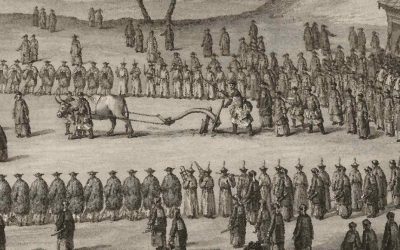
The ox and the ritual plow in springtime
The ox and the ritual plow in springtime Throughout the imperial era, every year the beginning of agricultural work was celebrated by a solemn ceremony called the Plowing Festival. "The emperor himself would take a yellow plow attached to a yellow ox (yellow was the...
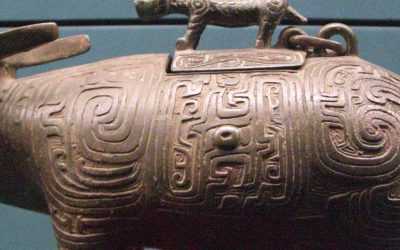
The bull and the political development of Neolithic China
The bull and the political development of Neolithic China Since the history of the penetration of domestic cattle in China goes parallel to that of the political concentration that gave rise to the first cities and later to the first states, that slow penetration of...