


History of the Zhuang nationality in China
It is widely thought that the ancestors of the Zhuang were the ancient Yue. But there are no unanimity about the character, history and territory of these Yue. One people called “Yue” appears in the Chinese chronicles of the Shang Dynasty. This same name is more and more frequently used, to denominate a kingdom that, established near today Hangzhou, played a preponderant role in the middle stages of the Warring States period.
After the destruction of Yue Kingdom, vanquished by Chu Kingdom in 334 B.C., it is supposed that the Yue suffered a period of political disintegration and migration who gave origin to the peoples called Baiyue or Hundred Yues.
The name Baiyue is a generic name for different peoples who shared some cultural characteristics, who inhabited the lowlands of South and Southeast China.
Following this kind of linear descend, not completely probed until now, from ancestors who lived in today Zhuang lands in a remote past, usually it is attributed to them three important cultural characteristics:
– To be the first to grow buckwheat.
– To have been the authors of the magnificent paintings of the Huashan cliffs, that stretch 200 kilometers along the river bank.
– To have developed and maintained the cult to the bronze drums. Guangxi has been the place where more old bronze drums have been discovered, a musical instrument who still have an important religious and ritual valor for the ethnic groups of Guangxi.
The Chinese started to have a regular presence in nowadays Guangxi Province ( Zhuang territory) after the first emperor Qinshihuang built the Linqu Channel to send his army to conquer Canton. Though this communication was interrupted after the fall of the Qin dynasty, the new conquest of Canton and the north of Vietnam in times of Han Wudi, started the regular contacts between the ancestors of the Zhuang with the Chinese people.
Most of the Zhuang lands were officially governed from Canton, but during many years it was only a nominal control of the main ways of communication, and every attempt of impose effective Chinese rule on the aborigines of Guangxi, was fierily contested by them.
After the fall of the Han dynasty and the division of China in Three Kingdoms, the pressure on the peoples of the far south was increased by a Wu Kingdom who, based in Nanjing, felt the need to increase its territorial base.
Tang effective domination of Guangxi
The effective integration of Canton in the imperial sphere of power during the Tang dynasty contributed to accentuate the pressure on the Zhuang. A continuous flow of migrants and the buildup of the Chinese military power in Guangxi ended the last hopes of a Zhuang independent political entity with the Song dynasty.
As Barlow (1) points: «for the Zhuang, the Song era (960-1279 A.C.E.) marked a critical transformation. From that point forward they would be recognized as a coherent ethnic group with a distinctive culture and history. But the Song era also marks the last time at which the Zhuang might have remained an independent ethnic group organized under their own leadership.»
In the Yuan dynasty the Zhuang began to be governed by the tusi system, where local headmen were appointed to govern in the name of the emperor. But the tusi system, at the same time that provided certain autonomy, assured that the minority submitted to the imperial power.
During the Ming dynasty, as the march to the tropics increased the Chinese pressure on the Zhuang lands, Guangxi saw some of the most ferocious rebellions protagonized by the Zhuang. The military suppression of every rebellion was a step more in the complete subjugation of the Zhuang.
«Early Qing sources guessed that of the total population of Guangxi, «half were Zhuang, 30 percent Yao, and 20 percent Han. Ming sources indicate that 80-90 percent of the population of Guilin prefecture was Yao, and 70-80 percent of Liuzhou too was Yao. By the 1940s, Han Chinese constituted about 60 percent of the population of Guangxi.» «In the western half of the province the early Ming administrative system recognized some 49 «ji mi» or «loosely controlled,» administrative districts (zhou), which were governed by hereditary tribal chiefs who nominally reported to the nearest Chinese military post and were liable for paying taxes.» (2)
The Zhuang, even sharing with the Chinese the use of the same ecological strata, kept firmly their identity during many centuries thanks to their bellicose character and the musical transmission of their traditions.
After the 19th century
In the 19th century, many Zhuang embraced the messianic revolution that swept Guangxi province, known as the Heavenly Kingdom of the Taiping. But this was more a political than an ethnical movement. The defeat of the revolutionary armies brought countless suffering to the Zhuang population.
After the communist revolution of 1949, the Zhuang were assigned Guangxi as their autonomous region. The moving of the capital to Nanning, were the Zhuang were majority, was a fatal gift for the Zhuang, who several decades later become minority also in this place.
Today, though most of the external folkways make difficult to differentiate the Zhuang from other peasant populations south of China, they have a rich cultural and religious life of their own, a product of their long history and ethnic heritage. Rituals and ceremonies, beliefs and religious activities, games and festivals, all them separate the Zhuang from neighboring populations, and, sometimes, also from the Zhuang living in other areas.
(1) Jeffrey Barlow.- The Zhuang: A Longitudinal Study of Their History and Their Culture.
(2) Marks, Robert, P.E, and Worster, Donald (Editor), and Crosby, Alfred W (Editor).- Tigers, Rice, Silk, and Silt: Environment and Economy in Late Imperial South China (Studies in Environment and History). Cambridge University Press. 2006.
Image: Author’s photograph taken in 2005.


Last posts
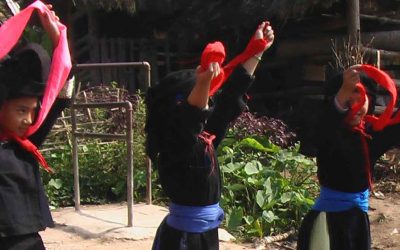
Some dances of the Zhuang people
Some dances of the Zhuang people The Zhuang have a number of dances. Originating from different periods of their history, it is thought that the older ones have a ritual origin, imitating the movements of their shamans during their religious ceremonies. In general...

Festivals of the Zhuang Nationality
Festivals of the Zhuang Nationality New Year The most important festival of the Zhuang year. Their celebration is similar to that of the local Chinese, although with some special characteristics. The children play their traditional games. In Wenshan County horse...

Zhuang phallic ritual
Zhuang phallic ritual Zhuang minority has an interesting phallic ceremony. According to their legends, in antique times there was no communication between the two banks of the Hongshui River, women living on one bank of the river and men on the other. The god...