


Chinese Herbal Medicine Shop in Weishan, Yunnan
China still maintains a strong tradition of using natural medicines, specifically herbs with medicinal properties that have been used for centuries. In addition to being present in the composition of many modern medications, some herbalists continue their traditional trade. Even in large cities, it is not uncommon to occasionally find herbalists selling fifteen or twenty products in their small stall or shop, each stored in a plastic bag. Usually, these products do not have labels, meaning that only an expert knows exactly what each medicine is.
Herbal medicine shop
In this shop, located in the ancient city of Weishan in Yunnan province, we find what could be described as the pinnacle of Chinese herbal medicine. Within this traditional house on the main street of the old town, we discover a unique display of medicinal herbs. On the left, some medicines are neatly arranged in white plastic bags, this time identified with small labels. Higher up, in a small nod to modern civilization, others are carefully placed in plastic bottles.
A unique shop in China
However, what makes this shop stand out from all the other similar stores and stalls across China is the sheer volume of herbs stored in the white and green sacks seen on the right side of the image. It is well known that each medicinal herb must be harvested at a specific time of the year and that many of these herbs are needed in large quantities to be therapeutically effective. The foresight of this traditional pharmacist creates a truly unique scene in the ancient city of Weishan.
Wonderful Weishan Old City
Weishan is one of the oldest cities in Yunnan province. Officially designated as an autonomous district for the Yi and Muslim communities within the Bai Autonomous Prefecture of Dali, Weishan boasts significant historical, artistic, and cultural attractions. Among them, the Ancient City, with thousands of well-preserved buildings, and Weibaoshan Mountain, located 10 km from the city, stand out as the most important Taoist mountain in Yunnan.
This is why we include this city in almost all of our itineraries in Yunnan.


Last posts

Chinese character 吹 chuī – cook
Chinese character 吹 chuī – cook ① cookHSK - STROKES - 8 RADICAL - 火 Elements ---- An open mouth 欠 + a fire 火 . Phonetic series 欠. To blow 吹 (chuī phonetic) to the fire 火 to stir it up and start cooking.炊具 chuījù cooking utensils.More posts on Chinese...
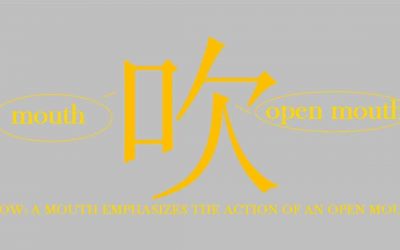
Chinese character 吹 chuī – blow, play (wind inst.)
chinese character 吹 chuī – blow, play (wind inst.) ① blow ② play (wind instruments) ③ boast, brag HSK - STROKES - 4 RADICAL - 口Elements ---- An open mouth 欠 + a mouth 口. Phonetic series 欠. An open mouth 欠 expels air 口, blowing, playing a wind instrument, or...
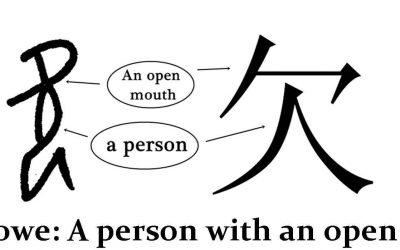
Chinese character 欠 qiàn – lack, owe
chinese character欠 qiàn – lack, owe ① lack, owe ② short of, lacking. ③ lean forwad HSK - STROKES - 4 RADICAL - 欠Elements ---- Pictogram of a person with the mouth open. Phonetic series 欠. The upper part evolved from the pictogram of an open mouth. A person人with an...
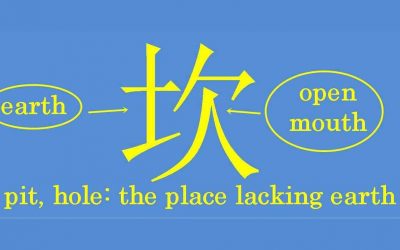
Chinese character 坎 kǎn – pit, hole
Chinese character 坎 kǎn – pit, hole 1. pit, hole 2. bank (of river) 3 ridge HSK - STROKES - 7 RADICAL - 土Elements ---- Open mouth 欠 + earth 土. Phonetic series 欠. A pictogram of a hole in the earth: the place lacking 欠 earth 土.垄坎 lǒngkǎn ridge between fields.In OBC...

Introducing the Dong nationality
The Dong are one of the minorities of China with a large population. According to the census of the year 2000 their population was 3,000,000 people. They live mainly in Guizhou Province (approximately 1,800,000 people), along a fringe of flat lands that cross the...
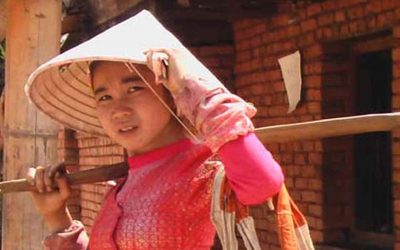
The Dai of Dehong Prefecture
Santasombat, Yos. Lak Chang: A Reconstruction of Tai Identity in Daikong. Canberra, AUS: Pandanus Books, 2001. p 1. (Introduction) The Tai ethnic group, in its different branches, is beyond any doubt one of the most widespread of any ethnic group in the Southeast...