


An Old Book on the Sani-Yi Minority
One may wonder whether it makes any sense to read, in the first decades of the 21st century, a book written at the end of the 19th. Clearly, the person who has spent some of their time translating it, revising it, updating the old names into modern spelling, and editing it as a book, is going to answer affirmatively. Therefore, that answer holds no weight unless backed up with some reasons.
The first and most obvious reason is that this short book, although titled “The Lolos”, is the first and only monograph existing in any Western language on the branch of the Yi people known today as the Sani, who call themselves gni, as already noted by Paul Vial. That is, since the writing of this book, no further book-length study of the Sani has been published in any Western language.
The second reason is that, being a book published in French, it has gone almost unnoticed by researchers in other countries, who, as usual, search for study materials in English. This is a major oversight in the case of Yunnan, where French authors of the late 19th and early 20th centuries provided extremely valuable material on the life and society of Yunnan’s inhabitants—both Han Chinese and minorities. Especially interesting are the chronicles of missionaries who, despite being steeped in a paternalism that would now be considered unacceptable and a colonial mindset they cannot quite hide even in their most well-meaning writings, provide firsthand material about the life and culture of those peoples due to the many years they lived among them.
Third, the book itself presents very interesting material. In fact, some of the cultural and religious descriptions provided by the author have barely been studied since. Some of them may help us understand cultural concepts among the Yi and related peoples that have seen little research since Vial’s time.
It’s clear that this work needs to be read contextually, with an awareness of the author’s perspective—a very particular kind of missionary who believes he has found among the Gni a people isolated from Chinese influences, ready to receive Catholic teachings, and who sees himself offering his life for the salvation of the Yi people’s souls. The historical context must also be considered: while China’s last dynasty, the Qing, was crumbling—bringing down with it the imperial regime that had shaped China for the last 2,000 years—France was growing more secular, and missionary work was increasingly viewed with skepticism. Moreover, France and China had clashed in the Franco-Chinese War of 1884–85, which granted France an «influence zone» in Yunnan, Guangxi, and southern China.
That war is key to understanding why Chinese people were often unfriendly toward French missionaries, and why those missionaries showed little sympathy toward the Han Chinese in turn. This also explains why many missionaries focused on evangelizing minority populations, who tended to be more receptive.
In that sense, Vial’s humility is striking. His writing is so succinct it sometimes seems like he’s apologizing for lingering on a topic, as though he feared the reader might get bored—as though the life, culture, and religion of the Lolo/Gni/Sani would interest no one.
Of particular value is his brief, unfortunately less than a page-long, description of the Sani pictographic script, as well as the bilingual Sani–French edition (which we have preserved in this edition, translating it below the original) of the people’s main myths: the Creation of the World, the Great Drought, and the Flood.
One of the hardest paradigms to justify in 20th-century anthropology is the idea that descriptive studies of human communities are no longer worthwhile. That kind of work was considered a thing of the past—even though many peoples, such as the one this book covers, still lack any descriptive study of their society. This led to the absurd situation in which anthropologists and historians continually refer to human entities for which there is no documentation clearly defining who they are or what their core cultural features might be. And the excuse that societies are always changing doesn’t help here: we can, at the very least, describe what a society was like at a given moment.
In China, an attempt was made to overcome this gap through major foundational collections of knowledge on the national minorities. But since these were organized around the officially recognized nationalities (55 minorities plus the Han majority), and since many of these nationalities include highly diverse ethnic groups, it’s impossible to distinguish the defining features of each sub-group or ethnic branch.
There are, indeed, some historical and anthropological studies in Chinese focused on the Sani, and thankfully they are increasing in number—partly due to the Sani’s visibility, living as they do near one of Yunnan’s most popular tourist sites, the Stone Forest. They have become part of the collective image of traveling to Yunnan, with their colorful hats and serious blue vests, the large guitars the men dance with, and the women’s frequent, spontaneous dances.
Vial’s book also became a reference point for later linguistic and anthropological research in Yunnan and southern China more broadly, and some of his claims were hotly debated by researchers of the time.
For all these reasons, I believe it’s still important to make the words of someone who knew and loved the Sani almost 150 years ago accessible today.
To make this book easier to read for 21st-century readers, we’ve made the following changes:
- All Chinese names have been converted to pinyin for easier reading.
- We’ve clarified some of the more obscure concepts in the original narration, distinguishing Paul Vial’s own notes (marked as N. del A.) from our modern explanatory notes (marked as N. del T. or sometimes unmarked).
This edition also includes the short text The Spirit and the Heart among the Lolos, published in 1905, which offers a firsthand view of how Vial saw his love for the Lolos and how those close to him perceived it. It also contains a translation of the myth The Origin of the Rainbow, which heavily influenced his research on Sani culture. The book also includes a translation of the first ethnological description of the Yi: The Lolos by François Louis Crabouillet.
We hope the effort has been worth it.
This is the introduction to the book: Paul Vial, Paul. Los Lolos: Historia, religión, costumbres, lengua, escritura Edited, translated and annotated by Pedro Ceinos Arcones
About me: I have spent 30 years in China, much of the time traveling and studying this country’s culture. My most popular research focuses on Chinese characters (Chinese Characters: An Easy Learning Method Based on Their Etymology and Evolution), Matriarchy in China (there is a book with this title), and minority cultures (The Naxi of Southwest China). Yo can see my mis videos in Youtube, and more pictures about China in Instagram (pedroyunnan).
In travel, I have specialized in Yunnan, Tibet, the Silk Road, and other lesser-known places. Feel free to write to me if you’re planning a trip to China. The agency I collaborate with offers excellent service at an unbeatable price. You’ll find my email below.


Last posts

The value of the Taotejing, the sacred book of the Taoists
In Peter Goullart The Monastery of the Jade Mountain. Unlike the Bible and the Koran. the Taoteking does not refer to the historical processes which led men, or rather a particular tribe among men, to the idea of One God. Neither does it describe in detail how this...

The Blue Women of China of the Yao minority
The Blue Women of China of the Yao minority Many people have heard of the Blue Men of the Sahara (the Tuareg), but few have heard of the Blue Women of China. And in fact among the women of the so-called Landian Yao or Landen Yao outside China, the production, dyeing...
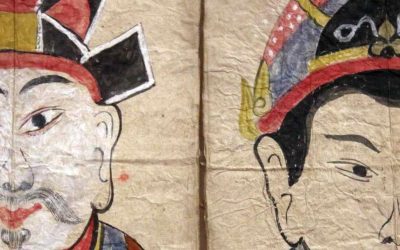
The Landing Yao Ancestral Festival of July
The Landing Yao Ancestral Festival of July All around China, the seventh month of the lunar calendar is known as the month of the ghosts, because in this month is celebrated the Mid-Year Festival. The Mid-Year Festival has nowadays many variations and it includes a...

We are lucky- A list of free books about the Zhuang
Free books about the Zhuang Fortunately for the lovers of the Zhuang nationality culture and language, there are some books, freely available to all the interested readers. Here, there is a list of the books we know are in this moment free to read and/or download....
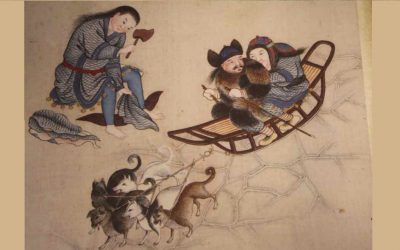
Tales of the faithful dog: China, Mongolia, the West
In Chinese culture there are many historical and folkloric stories that extolled dogs, placing the animal friend above the other human beings. This was due to the dogs fidelity to their master, one of the most appreciated virtues in Chinese society. In legends,...
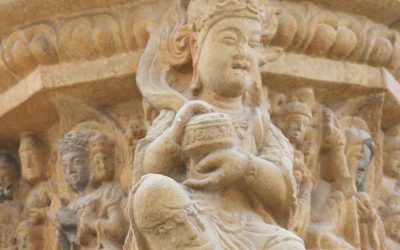
The path to Nirvana in the Kunming Dharani Pillar
The path to Nirvana in the Kunming Dharani Pillar The main courtyard of the Kunming Municipal Museum houses one of the most original art-works from the time of the Dali Kingdom (937-1253 CE) in Yunnan. It is called the Dharani Pillar of the Dizang Temple. It is a...