


The Smallpox Goddess (Doushen)
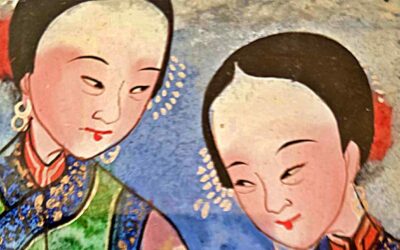
The Smallpox Goddess (Doushen 痘神) is part of a group of goddesses whose primary role was the protection of children. In the final years of the imperial era, they operated under the authority of Bixia Yuanjun, the daughter of the Emperor of Mount Tai (Taishan). Since Mount Tai was traditionally the place where the souls of the dead were judged and where the infernal registers containing each person’s date of birth and death were kept, it is not surprising that a deity emerged who managed the more benevolent aspects of those records: a divine mother to whom real mothers prayed throughout the year for their children’s health.
The Smallpox Goddess was both feared and revered, as she was believed capable of both inflicting the disease on children and protecting them from it. Prayers were offered to her to prevent children from catching smallpox and, if they had already contracted it, to ensure the illness ran a mild course and that they recovered quickly. “The resulting pockmarks were considered so unsightly that Chinese children would wear ugly paper masks to bed on the last night of the year, hoping to trick the Smallpox Goddess into passing them over. Others hung an empty gourd near their beds, into which the goddess could ‘empty’ the smallpox. Smallpox pustules, and the disease itself, were usually referred to euphemistically as ‘heavenly flowers’ or by other names, to avoid offending the goddess” (Smith 1899).
She was sometimes worshipped at home on small red altars erected in her honor, where mainly cold food offerings were presented. At other times she had her own temples or dedicated chapels within village and town temples. In some regions a strict prayer protocol was followed: offerings were made to the goddess on the 3rd, 5th, 7th, and 9th days after the disease appeared, with a grand tribute on the 14th day, when the child was considered out of danger. The ceremony concluded, in some places one month after the onset of the illness once the patient was cured, by taking the goddess’s image to a paper boat and setting it adrift on a river or canal. A small boat made of paper or straw, called the Smallpox Boat, was built; the used offerings, the red paper from the altar, and sometimes a paper figure representing the goddess were placed inside. The boat was then carried in procession and either burned or launched into a river, symbolizing that the goddess was departing, taking the disease with her.
There were also other goddesses responsible for specific aspects of the illness, such as:
– the Goddess of Spots/Pockmarks (痘疹娘娘, Douzhen Niangniang),
– the “Five Ladies of Smallpox” (五痘娘娘, Wudou Niangniang), who represented the different types or stages of the disease,
– Mashen (麻神), who dealt with the scars left by smallpox,
– and the spirit Banshen (瘢神), regarded as the son of the Smallpox Goddess, who specialized in curing the disease in its most dangerous phases, when the pustules turned gray.
For further reading:
– Doolittle, Justus. Social Life of the Chinese, with some accounts of their religious, governmental, educational and business customs and opinions with special but not exclusive reference to Fuhchau, Volume I. Harper & Brothers, New York, 1865.
– Dore, Henri. Researches into Chinese Superstitions. Vol. X. Shanghai, 1933.
– Smith, Arthur H. Village Life in China: a study in sociology. Fleming H. Revell, New York, 1899.
If you are interested in these topics, you might enjoy the following books by the same author (in Spanish):
Leyendas de la diosa madre: y otros mitos de diosas y mujeres de los pueblos de China
About me: I have spent 30 years in China, much of the time traveling and studying this country’s culture. My most popular research focuses on Chinese characters (Chinese Characters: An Easy Learning Method Based on Their Etymology and Evolution), Matriarchy in China (there is a book with this title), and minority cultures (The Naxi of Southwest China). In my travels, I have specialized in Yunnan, Tibet, the Silk Road, and other lesser-known places. Feel free to write to me if you’re planning a trip to China. The agency I collaborate with offers excellent service at an unbeatable price. You’ll find my email below.


Last posts
Suicides en the east suicides in the west
In early November 2022, my friend, the psychiatrist Luz González Sánchez, told me she was preparing a presentation on suicide. On the 8th of that month, during a quiet moment, I briefly reviewed some of the types of suicide characteristic of China and sent it to her...
Imperial Processions to the Temple of Heaven
Imperial Processions to the Temple of Heaven Those who know China—even if only through a brief trip—and who have visited the Temple of Heaven in Beijing will surely have been fascinated by the sober beauty of its buildings. Yet, whether on a crowded day or during a...
Most Frequent Scenes from the Life of the Buddha in Tibetan Art
Most Frequent Scenes from the Life of the Buddha in Tibetan Art In fact, only a few moments are repeated very frequently in Tibetan paintings. In some versions there are eight—an auspicious number for Tibetans, corresponding to the Noble Eightfold Path and the eight...
The Dog as Psychopomp in China
The Dog as Psychopomp in China One of the oldest human beliefs was that after death there existed an immaterial part of the person—later called the soul or spirit—that did not disappear with the body. Its origin may lie in the “presence” of the dead in dreams,...
An ambitious project to rewrite history
An ambitious project to rewrite history. It is what we see in Lhamsuren Munkh-Erdene, The Nomadic Leviathan. A Critique of the Sinocentric Paradigm. Brill. Leiden. 2023. Now free to download in the publisher’s webpage. This book is a critique of a theoretical paradigm...
Why I devoted more than a year to researching suicide in Chinese culture
Why I devoted more than a year to researching suicide in Chinese culture In early November 2022 my friend, the psychiatrist Luz González Sánchez, told me that she was preparing a lecture on suicide. On the 8th of that same month, during a quiet moment, I made a brief...