


The Solution to the West’s Suicide Epidemic Can Be Found in the Culture of a Himalayan People
In recent years, the number of suicides among young people has skyrocketed. In some countries, such as Spain, suicides have already surpassed traffic accidents as the leading cause of death not caused by illness—and among the young, they are the main cause of death in every sense.
In my recent book on suicide, I cite the words of psychologist James Hillman: “The mind sometimes needs to kill, and it will not stop until it succeeds.” I also warn that this death is psychological. In other words, the mind sometimes needs to destroy a situation that causes it anguish in order to continue living a healthy life in the future.
As I also point out in that book, this psychological death—or rather, these psychological deaths—were carried out in traditional societies through rites of passage. Through rituals that mixed fear, violence, and abandonment, people felt they were killing their former self to be reborn into a new one. It is no coincidence that many of these rites took place in dark huts or caves, associating the end of the ritual with a new birth. Today it would be impossible to revive such rites; having lost faith, they would be empty ceremonies.
But there are other ways to kill the self without killing the person—ways to end everything that makes us feel like abandoning life, without actually abandoning it—and the solution comes from the culture of the Naxi minority in China, on the eastern edge of the Himalayas.
For many years, anthropologists have characterized this society by its preservation of traditional culture (including its pictographic Dongba script) and its high rate of suicide among young people, who were said to protest arranged marriages in this way.
However, testimonies I collected during my own fieldwork among this minority suggest that most of these suicides were not suicides at all. They were only staged. In reality, the couple fled to the nearby Jade Dragon Snow Mountain, with its hard-to-reach valleys, and instead of hanging themselves, taking poison, or jumping off a cliff, they went on living together. For several years they endured a harsh life high in the mountains, and after a suitable period—already holding in their arms the child born of their love—they returned home. The joy of seeing them alive again outweighed all social considerations.
They show us that it is possible to kill the “present self” without killing the person, and they offer an example—both to young and old—of the human capacity to find a way out of situations that seem to have none.
To learn more, you can read my book: The Culture of Suicide in China and the Fall of the Imperial Regime.(Spanish language).
About me: I have spent 30 years in China, much of the time traveling and studying this country’s culture. My most popular research focuses on Chinese characters (Chinese Characters: An Easy Learning Method Based on Their Etymology and Evolution), Matriarchy in China (there is a book with this title), and minority cultures (The Naxi of Southwest China). In my travels, I have specialized in Yunnan, Tibet, the Silk Road, and other lesser-known places. Feel free to write to me if you’re planning a trip to China. The agency I collaborate with offers excellent service at an unbeatable price. You’ll find my email below.


Last posts
Suicides en the east suicides in the west
In early November 2022, my friend, the psychiatrist Luz González Sánchez, told me she was preparing a presentation on suicide. On the 8th of that month, during a quiet moment, I briefly reviewed some of the types of suicide characteristic of China and sent it to her...
Imperial Processions to the Temple of Heaven
Imperial Processions to the Temple of Heaven Those who know China—even if only through a brief trip—and who have visited the Temple of Heaven in Beijing will surely have been fascinated by the sober beauty of its buildings. Yet, whether on a crowded day or during a...
Most Frequent Scenes from the Life of the Buddha in Tibetan Art
Most Frequent Scenes from the Life of the Buddha in Tibetan Art In fact, only a few moments are repeated very frequently in Tibetan paintings. In some versions there are eight—an auspicious number for Tibetans, corresponding to the Noble Eightfold Path and the eight...
The Dog as Psychopomp in China
The Dog as Psychopomp in China One of the oldest human beliefs was that after death there existed an immaterial part of the person—later called the soul or spirit—that did not disappear with the body. Its origin may lie in the “presence” of the dead in dreams,...
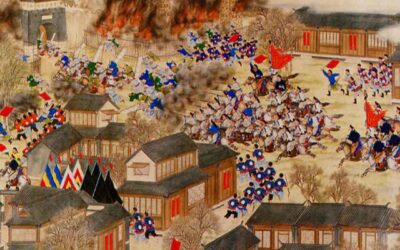
An ambitious project to rewrite history
An ambitious project to rewrite history. It is what we see in Lhamsuren Munkh-Erdene, The Nomadic Leviathan. A Critique of the Sinocentric Paradigm. Brill. Leiden. 2023. Now free to download in the publisher’s webpage. This book is a critique of a theoretical paradigm...
Why I devoted more than a year to researching suicide in Chinese culture
Why I devoted more than a year to researching suicide in Chinese culture In early November 2022 my friend, the psychiatrist Luz González Sánchez, told me that she was preparing a lecture on suicide. On the 8th of that same month, during a quiet moment, I made a brief...