


Discover China’s Largest and Most Beautiful Salt Lake
The development of tourism and transportation in China is bringing to light places that were previously very hard to access and virtually unknown. Some of these destinations are beginning to gain a certain reputation, at least among those of us who keep up with the latest news in tourism and travel in China. One such place is Qarhan Salt Lake in Qinghai Province, just between Tibet and the Silk Road..
Better Than the Famous Qinghai Lake
While the province of Qinghai has long been known for its namesake lake—called Kokonor by the Mongols—this other lake remained little known and was only mentioned in a few very specific guides as a secondary or complementary visit. However, having visited both lakes, I believe Qarhan is far more beautiful and much more interesting. I had the bad luck of visiting on a cloudy day with very strong wind. I think I got a small taste of the famously unpleasant wind of the Changtang Plateau. At times, it really felt like the wind could blow me straight into the water.
A Beautiful Beach on a Stunning Lake
What visitors usually see is actually a beach on this enormous lake, which spans 5,800 square kilometers. Until the 1950s, no one paid much attention to it, although it was known to the Mongols living in the area, who gave it its name. Later, with the onset of economic development, it was discovered that a salt lake could provide many chemical compounds useful for the country’s growth. Several industries were established on its shores. Some of these still exist, and travelers pass through their production facilities on the way to the most beautiful part of the lake.
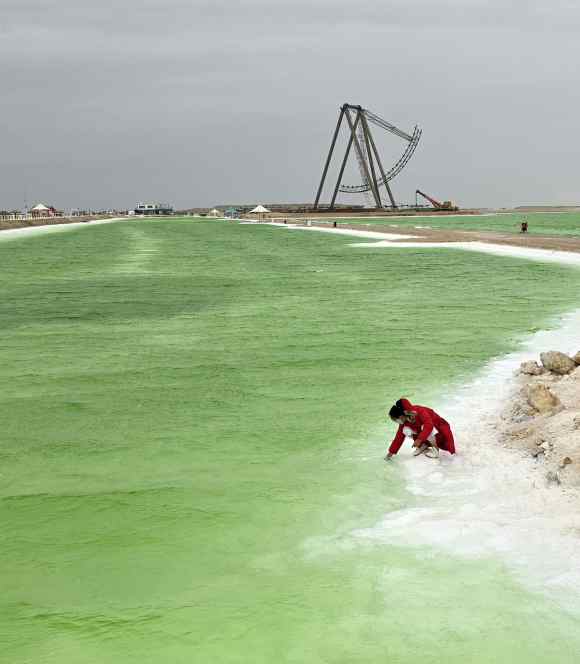
Emerald Green Waters on a Salt Beach
The beach stands out mainly for the intense green color of its waters and the contrast between the white salt along the shore, the vivid green hue of the water in that area, and the blue of the sky—when it is blue—or the gray, as it was during my visit, which also created a truly striking contrast. In keeping with the poetic spirit with which natural elements are often described in China, some of the most beautiful spots have been given names that allude to jade—found in this region—and to emerald, whose color the waters imitate.
A Visit Worth Making
This is actually the largest salt lake in China and the second-largest in the world. The lake is just 60 km from the city of Golmud. There’s a public bus in the morning and another in the afternoon, and hiring a taxi is not expensive (around 200 yuan for the round trip, including waiting time, in the low season of 2025). The visit can take about two to three hours, including the transfer from the entrance gate, but on a good day, it can easily be extended or even turned into a full-day excursion.
About me: I have spent 30 years in China, much of the time traveling and studying this country’s culture. My most popular research focuses on Chinese characters (Chinese Characters: An Easy Learning Method Based on Their Etymology and Evolution), Matriarchy in China (there is a book with this title), and minority cultures (The Naxi of Southwest China). In my travels, I have specialized in Yunnan, Tibet, the Silk Road, and other lesser-known places. Feel free to write to me if you’re planning a trip to China. The travel agency I collaborate with offers excellent service at an unbeatable price. You’ll find my email below.


Last posts

Suicides en the east suicides in the west
In early November 2022, my friend, the psychiatrist Luz González Sánchez, told me she was preparing a presentation on suicide. On the 8th of that month, during a quiet moment, I briefly reviewed some of the types of suicide characteristic of China and sent it to her...
Imperial Processions to the Temple of Heaven
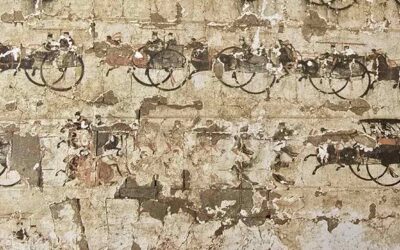
Imperial Processions to the Temple of Heaven Those who know China—even if only through a brief trip—and who have visited the Temple of Heaven in Beijing will surely have been fascinated by the sober beauty of its buildings. Yet, whether on a crowded day or during a...
Most Frequent Scenes from the Life of the Buddha in Tibetan Art
Most Frequent Scenes from the Life of the Buddha in Tibetan Art In fact, only a few moments are repeated very frequently in Tibetan paintings. In some versions there are eight—an auspicious number for Tibetans, corresponding to the Noble Eightfold Path and the eight...

The Dog as Psychopomp in China
The Dog as Psychopomp in China One of the oldest human beliefs was that after death there existed an immaterial part of the person—later called the soul or spirit—that did not disappear with the body. Its origin may lie in the “presence” of the dead in dreams,...
An ambitious project to rewrite history
An ambitious project to rewrite history. It is what we see in Lhamsuren Munkh-Erdene, The Nomadic Leviathan. A Critique of the Sinocentric Paradigm. Brill. Leiden. 2023. Now free to download in the publisher’s webpage. This book is a critique of a theoretical paradigm...
Why I devoted more than a year to researching suicide in Chinese culture
Why I devoted more than a year to researching suicide in Chinese culture In early November 2022 my friend, the psychiatrist Luz González Sánchez, told me that she was preparing a lecture on suicide. On the 8th of that same month, during a quiet moment, I made a brief...