


2,000-year-old paintings in a Chinese tomb
It has been more than 10 years since the publication of The complete collection of murals unearthed in China, a dozen or so books describing with abundant full-color photographs the frescoes discovered in Chinese tombs. Needless to say, archaeology works so fast that the work is already a bit outdated.
Taking a look at the volume dedicated to Shanxi province, I was struck by the fact that the book begins with a description of a small tomb from the Han dynasty, which is no longer extant. Knowing the distribution of the iconographic elements, however, I believe it will be of interest to all art and Chinese history enthusiasts.
In April 1959, the people’s commune of Zhangdian, Pinglu County, found a Han tomb with murals in the village of Zaoyuan. The tomb is a brick chamber with a vaulted roof, facing east. The main chamber is rectangular in plan, with an east-west length of 4.65, a north-south length of 2.25, and with a height of 2.1 meters. There is an auxiliary chamber on the south side, 1.7 deep, 1.13 long, and 1 meter high. The walls of the main chamber are 1.08 m high and are built with a single layer of smooth bricks placed one against the other. The murals were painted using «a layer of clay mortar 0.5 to 1 cm thick tempered with wheat husks that was first applied to the walls, and then a layer of plaster was coated as a base on which the murals were painted.» The murals were first sketched with light lines of ink, then the outlines and details of the figures and objects were traced with lines of dark ink, and then finished by filling in the paintings with red, yellow, blue, and other colors.
The paintings in these Han Dynasty tombs followed the iconographic motifs of lacquer painting on coffins or silk painting common in the Warring Kingdoms period: celestial bodies, deities or decorative patterns to venerate the tomb occupants and guide them to the immortal world. These motifs vividly reflected people’s views on life and death and cosmology.
The Zaoyuan village tomb has iconographic content that will help to understand the thinking of the time.
On the vaulted ceiling of the main chamber, nine white cranes with long necks and short tails were painted among flowing clouds and celestial bodies. The crane is an animal revered in China since prehistoric times. In the times immediately after the creation of this tomb, it became the preferred animal for Taoists to ascend to heaven. An idea that was already common in these times.
On the starting line of the east wall, the sun was painted, and on the west wall, the moon. The two stars are iconographically used to symbolize the continuous illumination in the world of darkness, and at the same time represent the balance between yin and yang.
The Four Supernatural Beings-the Green Dragon (east), the White Tiger (west) and the Dark Warrior (north)-were arranged by their directions, implying that the ceiling was represented as heaven or the immortal world. Each of these animals, we are missing the Red Bird in the south, symbolized and protected one of the cardinal points. The presence of the four in the tomb also delimits an earthly space, in which, as we shall see, some natural phenomena and people’s activities are described.
Below the celestial scene, the opposite sides of the walls were decorated with scenes of the earthly world, including mountains, rivers, and other landscapes, as well as paintings reflecting human activities, such as the «Plowing with oxen» on the west wall, the «Sowing with a machine» on the north wall, and «cart and horse» and other scenes of rural life.
With the publication of the paintings discovered in the ancient tombs, the presence of Chinese artwork is becoming more and more ancient. Moreover, since there are historical reports that the walls of Han dynasty palaces were decorated with paintings depicting moralizing scenes, they may present an approach to understanding the techniques and styles of those palace paintings now gone forever.
Shang Tongliu, Ma Sheng. Murals Unearthed from Shanxi Province. In Xu Guangyi. The complete collection of murals unearthed in China. Science Publishing. Beijing. 2011.
Yang Mogong Xie Xigong. Han Mural Tomb in Zaoyuan village, Pinglu, Shanxi. Gaogu.


Last posts
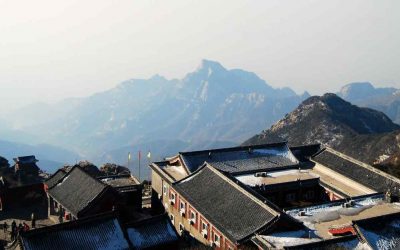
The sacred Taishan mountain
Taishan Mountain, life and death in Chinese culture, according to the work of Edouard Chavannes Mountains are, in China, divinities. They are considered as nature powers who act in a conscious way and who can, therefore, be made favourable by sacrifices and touched...

Family of characters 欠 qian
欠 qiàn – yawn; owe/ short of, lacking. The upper part evolved from the pictogram of an open mouth. A person人with an open mouth is yawning, or trying to compensate for the lack of air. 欠缺 qiànquē – lack/ be deficient of (lack + lack) 欠债 qiànzhài – owe a debt...
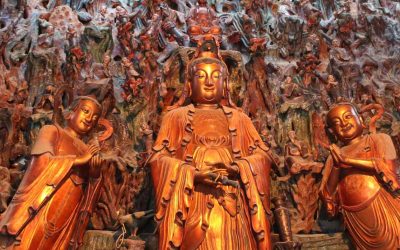
The Temple of the Soul Retreat in Hangzhou In 1930s
On the left side was a densely wooded rocky hill. Its steep slope was carved into fantastic figures of unicorns, leogryphs and other mythological animals, and statues of gods and saints. They had been fashioned out of rock by the monks more than fifteen centuries ago....